
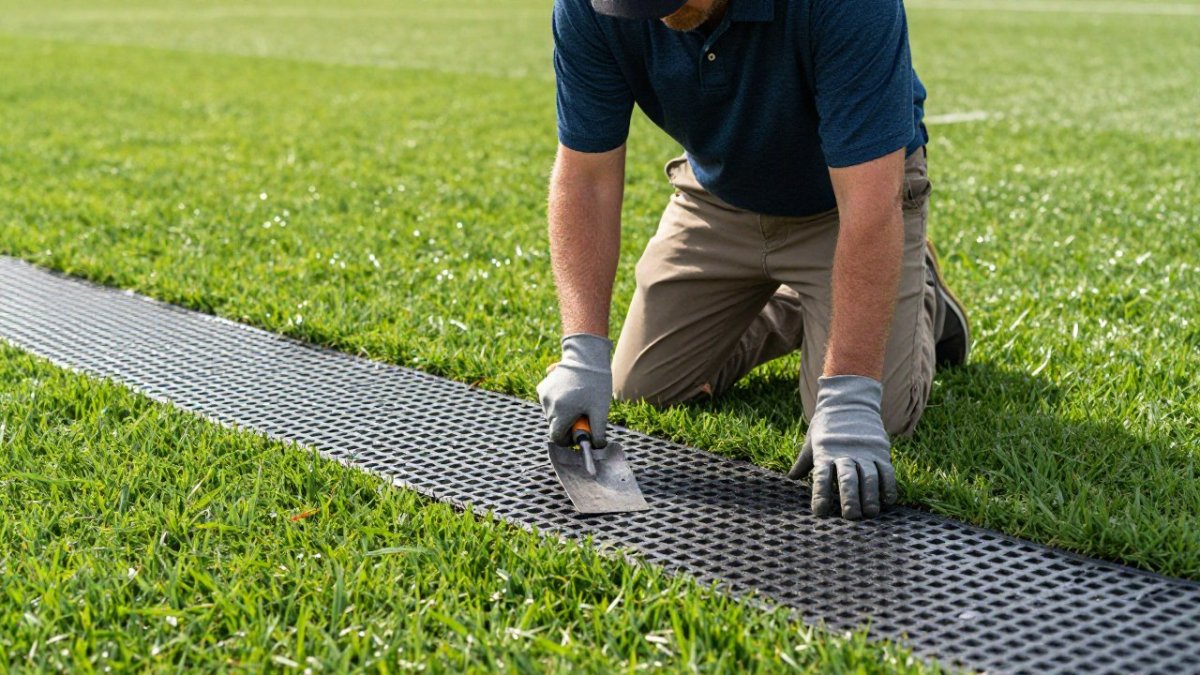
Last Updated: November 20, 2026
Quick Summary
A turf drainage system collects water through perforated backing and drainage holes, moves it through an aggregate base, and uses slope and grading to carry it to channel drains or subsurface outlets. Hole density is the first thing to check on any spec sheet, since turf with more drainage holes spaced closer together drains better.
- Drainage tiles under turf replace loose gravel in high-load applications.
- Site assessment should cover soil permeability, water table depth, rainfall intensity, and slope.
- Most drainage problems trace to clogged perforations, compacted base, collapsed outlet, or bad grade.
- Inspect perforations, aggregate, outlets, and grade annually.
- AirDrain is designed for 100% vertical drainage and made from 100% recycled content.
Table of Contents
- How a Synthetic Turf Drainage System Works
- 7 Benefits of Artificial Turf Drainage Done Right
- Drainage Tiles Under Turf and Synthetic Turf Base Drainage
- Drainage Rates, Site Assessment, and What Most Specs Get Wrong
- Artificial Turf Drainage Problems and How to Troubleshoot Them
- Climate, Heavy Rain, and Long-Term Performance
- Drainage System Costs and Trade-Offs
- Getting Synthetic Turf Drainage Right From the Start
- Frequently Asked Questions
How a Synthetic Turf Drainage System Works
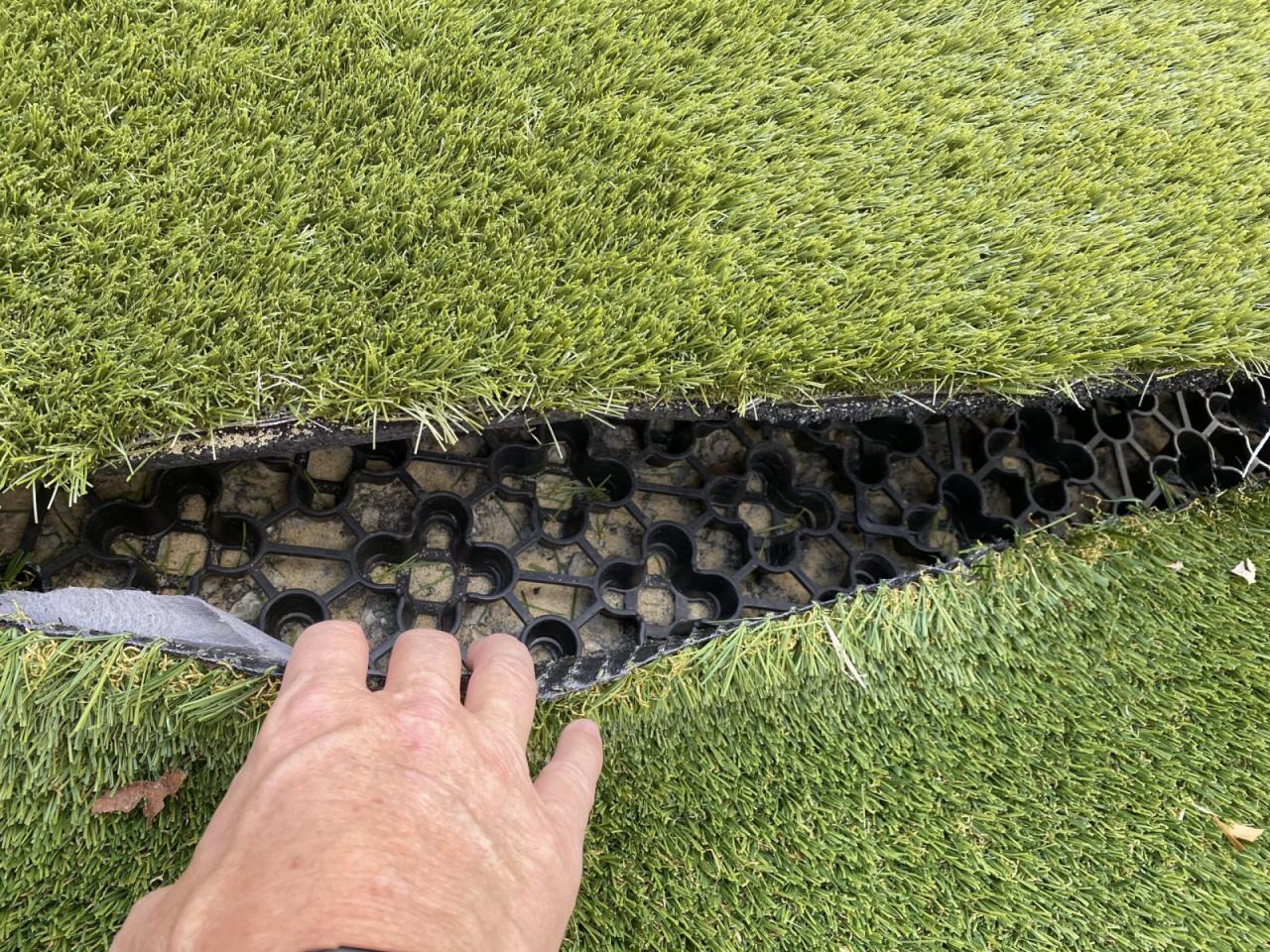
A synthetic turf drainage system is the engineered layer beneath artificial grass that collects water and moves it away before it pools. A structural geocell grid is one common way to build it, and whether a field drains or floods comes down to specification. Water enters through perforated backing and drainage holes, hits the aggregate base, and slope and grading carry it to channel drains or subsurface outlets. The New Jersey Department of Environmental Protection’s 2025 review notes that turf with more drainage holes, spaced closer together, drains better (EXTERNAL_LINK: Synthetic Turf – A Review of the Current Science | https://dep.nj.gov/wp-content/uploads/dsr/synthetic-turf-report-2025.pdf). See our artificial turf range for the profiles we design for.
7 Benefits of Artificial Turf Drainage Done Right
Done right, turf drainage can deliver returns such as faster drying, fewer puddles, and better playability. Our AirDrain system contributes to up to a 20% reduction in GMAX on synthetic sports fields, see our GMAX and HIC performance data and AirDrain benefits.
Drainage Tiles Under Turf and Synthetic Turf Base Drainage
Drainage tiles under turf replace loose gravel in high-load applications, and synthetic turf base drainage lives or dies on preparation: excavate, install geotextile fabric, compact aggregate in lifts, set grade toward outlets, lay the geocell grid, and connect to drains or pipe. Montgomery County’s 2024 oversight report confirms synthetic turf fields usually have a drainage system installed (EXTERNAL_LINK: A Comparison of Natural Grass and Synthetic Turf Athletic Fields | https://assets.montgomerycountymd.gov/files/OLOReport2024-12.pdf). See our sports field drainage page, then buy the system.
Drainage Rates, Site Assessment, and What Most Specs Get Wrong
Drainage rate is the volume of water a system clears per hour, and a high rate means nothing if the outlet can’t handle the flow. Site assessment comes first: soil permeability, water table depth, rainfall intensity, and slope set the real requirement. Western Resource Advocates examined artificial turf’s water-management benefits and drawbacks together (EXTERNAL_LINK: Is Artificial Turf a Beneficial Water Conservation Tool in the West? | westernresources.org).
Artificial Turf Drainage Problems and How to Troubleshoot Them
Most artificial turf drainage problems trace back to four failures: clogged perforations, a compacted base, a collapsed outlet, or grade that was never set correctly.
| Problem | Likely Cause | Fix | Impact |
|---|---|---|---|
| Standing water after rain | Clogged backing or infill | Deep clean, re-brush | Restores flow |
| Soft, spongy spots | Compacted or saturated base | Core test, re-grade | Restores stability |
| Water at field edges | Blocked channel drain | Clear and inspect outlets | Stops edge erosion |
Skipping the outlet inspection during installation is the most common cause of a system that passes its test and fails its first storm.
Climate, Heavy Rain, and Long-Term Performance
Heavy-rain performance is where climate-specific design matters most. Inspect perforations, aggregate, outlets, and grade annually.
Drainage System Costs and Trade-Offs
Cost depends on quantity, site conditions, and delivery, so pricing is best confirmed through AirField Systems’s website or a quote. Cheap drainage fails first and costs most. AirField Systems’s nesting design is intended to support efficient shipping and storage, and patented quick connectors are designed to simplify assembly.
Getting Synthetic Turf Drainage Right From the Start
The real challenge is matching drainage capacity to your site, rainfall, and load requirements before the base goes in. Our AirDrain geocell is designed for 100% vertical drainage, contributes to LEED points, and is made in America from 100% recycled content. With over 25 million square feet installed, AirField Systems has supplied sports fields, golf courses, green roofs, and pet relief areas. Specify a drainage layer that performs on the first storm and the thousandth.
Frequently Asked Questions
Does artificial turf have good drainage?
It depends on the backing and the base beneath it. Turf with more drainage holes, spaced closer together, drains better and can feel closer to natural grass, . Perforated backing alone is not enough: the aggregate base and sub-base must also move water away, or the surface will still hold standing water after heavy rainfall.
Can poor drainage cause odors or damage under synthetic turf?
Yes. Water that sits in the base layer creates wet spots and mud at the edges, keeps infill saturated, and can support bacteria and odor. Trapped moisture also shortens turf longevity and raises slip hazards on the surface. A subsurface drainage system with channel drains or drainage tiles under turf moves water out before it pools, which keeps the field usable and easier to maintain.
How do you choose a drainage system for a synthetic turf installation?
Start with a site assessment: soil type, slope, expected rainfall, and how the field will be used. Then match the drainage rate of the turf and base to that load, and confirm the aggregate base is compacted and graded to a defined outlet. Ask for independent performance data, including how the system affects GMAX on sports fields. AirField Systems can walk you through specification and current pricing for your project.
