
Quick Summary
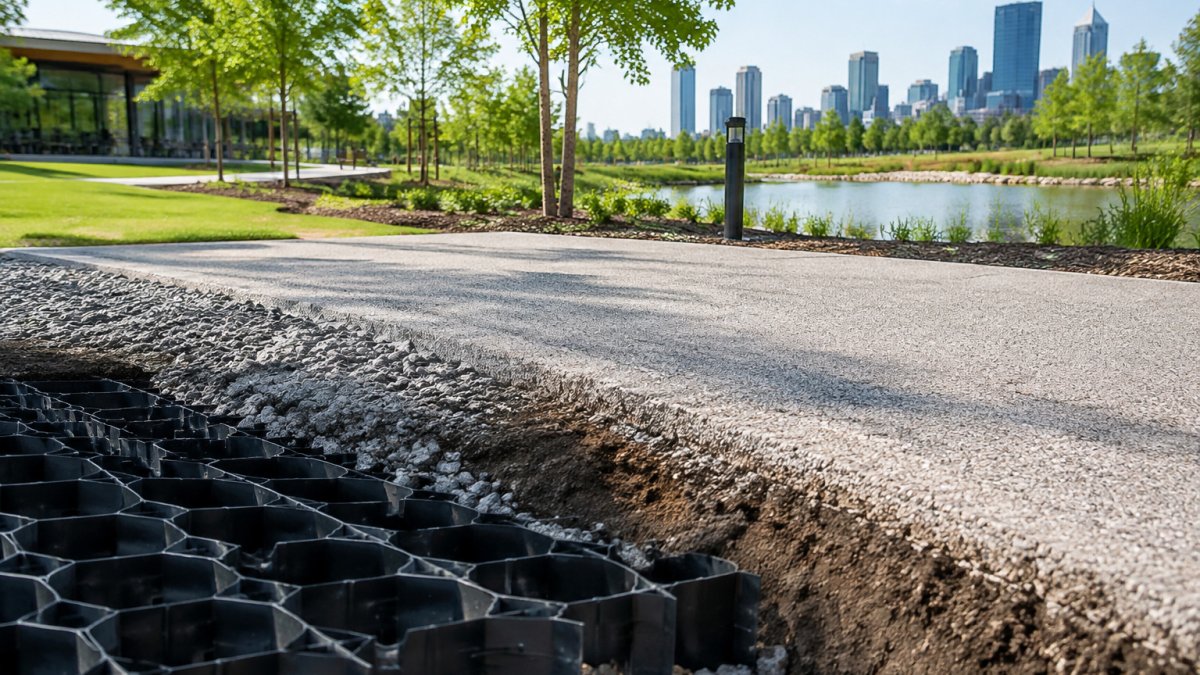
Sustainable infrastructure for municipal projects is public infrastructure planned, built and maintained to deliver services over its full life while limiting environmental harm and keeping long-term costs manageable. Planning it means weighing service delivery, climate resilience, asset condition and lifecycle cost together, not just the initial build price.
- Define goals up front, covering service delivery, climate resilience, asset condition and financial sustainability of maintenance.
- Pick three to five metrics and record a baseline before design, such as maintenance spend per square foot.
- Assess asset condition and map ponding, emergency access and maintenance hotspots before scoping the project.
- Compare two or three options on one lifecycle model covering installation, maintenance intervals and replacement timing.
- Write specifications around performance requirements and verify drainage after the first significant rain.
Table of Contents
- What Sustainable Infrastructure Means for Municipal Projects
- Economic, Social, and Environmental Benefits Municipalities Can Measure
- Step-by-Step Framework for Planning a Municipal Project
- Green Infrastructure for Municipalities: Stormwater, Water, and Urban Green Space
- Municipal Stormwater Management and Porous Paving Options
- Funding Sources and Lifecycle Cost Comparisons
- Overcoming Common Barriers: Capacity, Permitting, and Interagency Coordination
- Building Resilient Public Infrastructure That Performs Over Time
- Your Next Step: Scoping a Pilot Project With Your Public Works Team
- Frequently Asked Questions
Last Updated: November 23, 2026
Sustainable infrastructure for municipal projects is no longer a niche concern for public works departments. Stormwater rules, aging pipes, heat-island pressure and tight capital budgets are pushing city engineers to treat durability, water management and lifecycle cost as one decision rather than three. Municipal teams specifying porous paving and drainage products for fire lanes, parking and public open space often raise the same questions: what counts as sustainable, how do you prove it, and how do you pay for it?
What Sustainable Infrastructure Means for Municipal Projects
Sustainable infrastructure is public infrastructure planned, built and maintained to deliver services over its full life while limiting environmental harm and keeping long-term costs manageable.
For most cities, that means the design brief has to cover four things at once: service delivery, climate resilience, asset condition and the financial sustainability of maintaining what gets built. A road base that drains properly, a culvert sized for future storms and a porous surface that reduces runoff all meet that brief. A project that looks cheap at bid but needs early rehabilitation does not.
Many public works teams find that a clear written definition helps them stop debates about labels and start comparing options on performance. Defining the goals up front also makes it easier to justify a higher initial spend when the lifecycle numbers support it.
Economic, Social, and Environmental Benefits Municipalities Can Measure
Municipal benefits are easier to defend when they are tied to metrics a council can track. Economic benefits usually show up as lower lifecycle costs, fewer emergency repairs and reduced maintenance hours.
A practical approach is to pick three to five indicators before design starts and record a baseline. Examples include annual maintenance spend per square foot, number of ponding or flooding complaints, runoff volume from the site during a design storm and days of fire lane availability after rain events. Those numbers turn general sustainability claims into a record the department can report.
Qualified language is appropriate where local data is thin. Industry practitioners generally find that measured baselines improve how projects are judged after completion, even when the initial benefits are modest.
Step-by-Step Framework for Planning a Municipal Project
A repeatable planning sequence keeps sustainability criteria from being dropped late in the process. The framework below splits the work into three phases, each with a clear output the next phase depends on.
Phase 1: Assess Needs and Asset Condition
Start by inventorying what already exists. Pull condition ratings for pavements, drainage structures and green assets, and map where water currently ponds, where emergency vehicles struggle and where maintenance crews spend the most time. A common mistake is scoping a project around a visible symptom, such as a single flooded lot, without checking the drainage network that feeds it.
The output of this phase is a short needs statement: the service problem, the assets involved and the condition data behind it.
Phase 2: Design for Climate Resilience and Lifecycle Cost
Design against the storms and temperature ranges the site will actually face, not only the historical averages in the original specification. Evaluate two or three options against the same lifecycle model, including installation, expected maintenance intervals and replacement timing.
Document the design basis in writing. Engineers and reviewers can then check that the selected system matches the stated loads, drainage targets and maintenance capacity.
Phase 3: Procure, Build, and Commission
Write specifications that name performance requirements, not just products, and require submittals that prove them. Commissioning should include inspection against the design drawings, a documented drainage or infiltration check after the first significant rain, and a handover of maintenance instructions to the crew who will own the asset.
The framework splits planning into three phases, each with a clear output the next phase depends on.
| Phase | What to do | Output |
|---|---|---|
| Phase 1: Assess needs and asset condition | Inventory existing assets and map ponding, emergency access and maintenance hotspots | Short needs statement |
| Phase 2: Design for climate resilience and lifecycle cost | Design for actual storms and temperature ranges; compare two or three options on one lifecycle model | Written design basis |
| Phase 3: Procure, build and commission | Specify performance requirements; inspect, test drainage after first major rain, hand over maintenance instructions | Commissioned asset with maintenance handover |
Green Infrastructure for Municipalities: Stormwater, Water, and Urban Green Space
Green infrastructure uses vegetation, soils and permeable surfaces to manage water where it falls (the EPA).
Water infrastructure and urban green space overlap more than most capital plans acknowledge.
The primary constraints are maintenance access, soil conditions and the amount of space available. Selecting a green system that the local crew can maintain is more important than selecting the most ambitious one on paper.
Municipal Stormwater Management and Porous Paving Options
Porous paving lets rainfall infiltrate through the surface and into a structural base, reducing runoff from parking lots, access roads and overflow areas (the EPA).
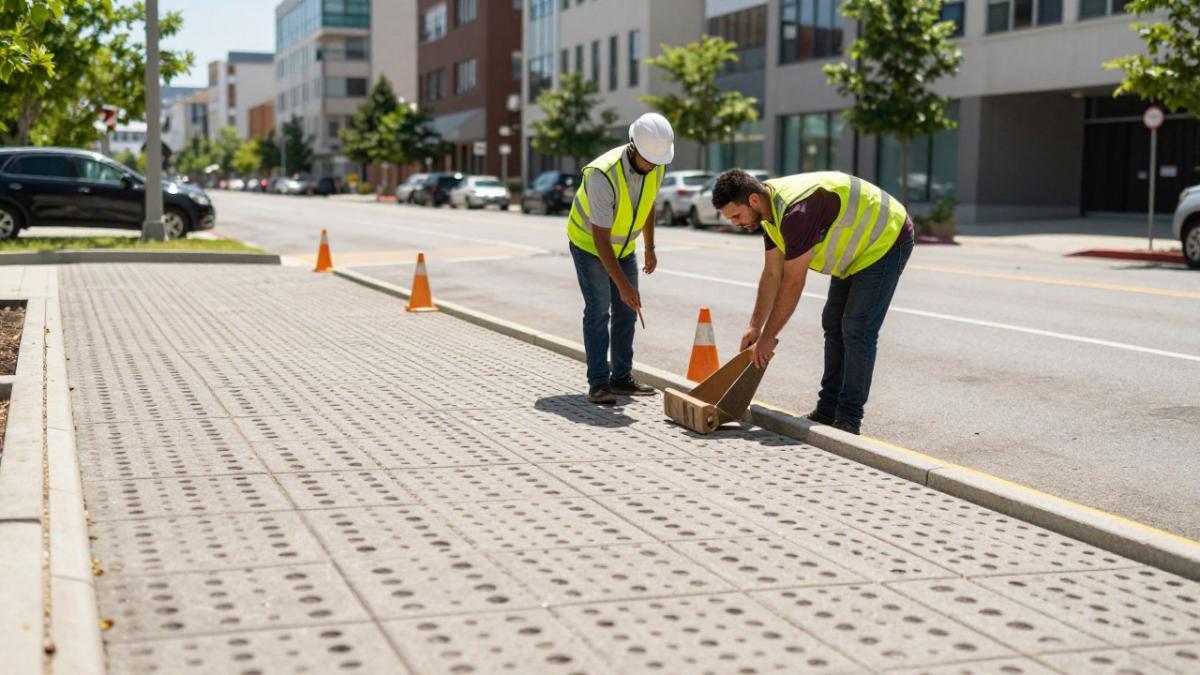
Each option trades off load capacity, appearance, maintenance and cost differently. For a closer look at how these surfaces hold up under repeated freeze-thaw cycles, see porous paving durability in freeze-thaw conditions.
When comparing options, check the stated load rating, the infiltration rate after years of use rather than when new, and the maintenance schedule the department can realistically sustain.
Funding Sources and Lifecycle Cost Comparisons
Municipal sustainable infrastructure is rarely paid for from a single source. Most projects assemble a stack of local capital, external grants, debt and dedicated fees, and the stack has to cover not just construction but decades of operation. Public works directors should confirm current eligibility, match requirements and award ceilings directly with the administering agency, because program rules and amounts change with each authorization cycle.
Matching the Funding Instrument to the Project
Each instrument carries different trade-offs in speed, control, reporting burden and who bears long-term risk.
- Local capital budgets and capital improvement programs. Fastest to deploy and fully under municipal control, but compete against every other department and are usually the first line cut in a tight year. Best suited to smaller pilots and to matching funds that unlock external awards.
- State revolving funds and clean water or drinking water programs. Low-interest loans administered through state agencies, often with affordability and green-project incentives. Attractive for water, wastewater and stormwater work, but require repayment from a dedicated revenue stream and carry application and environmental review timelines.
- Federal grant programs. Discretionary and formula awards for resilience, transportation and water projects. They can fund a large share of capital but typically require local match, procurement under federal rules, and reporting that strains small staffs.
- Municipal bonds. General obligation or revenue bonds spread cost across the asset life and align repayment with the beneficiaries. Require voter or council authorization, debt capacity and a credit story, and issuance costs make them inefficient for small projects.
- Stormwater utility fees. A dedicated, recurring revenue stream tied to impervious area or runoff contribution. They stabilize maintenance funding and can credit on-site infiltration, which makes them a natural fit for green infrastructure, but they require rate-setting and sometimes state enabling authority.
- Public-private partnerships and design-build-operate arrangements. Transfer design, construction and sometimes maintenance risk to a private partner and can accelerate delivery. They work best on large, well-specified projects; on small ones, transaction costs and contract complexity usually outweigh the benefit.
- Green infrastructure and resilience credit programs. Some state programs and utility credit mechanisms recognize infiltration, tree canopy or flood storage, effectively paying the project back through reduced fees. Confirm how credit is calculated and verified before counting on it.
A common pattern is to pair a grant or loan for capital with a utility fee or operating budget for maintenance. Watch out: projects funded only for construction often fail in year six, when the maintenance obligation arrives with no revenue behind it.
Building a Lifecycle Cost Model That Survives Review
Lifecycle cost comparisons are where many funding decisions are won or lost. A system with a higher upfront bid can still be the lower-cost choice if it avoids early replacement, reduces stormwater fees or qualifies for credit. Build the model so each cost component is visible and separately challengeable:
- Initial capital, design, permitting, materials, installation, contingency and escalation to the bid year.
- Routine maintenance, sweeping, joint refilling, mowing, reseeding, inspection labor and equipment, priced at the department’s loaded labor rate.
- Periodic rehabilitation, restriping, surface restoration, base repair and vegetation replacement at the intervals the manufacturer and local experience support.
- Replacement and end-of-life, removal, disposal and reconstruction at the expected service life, not the warranty period.
- Revenue and credit effects, stormwater fee reductions, utility credits and avoided flood response costs, shown as offsets rather than netted silently into capital.
- Risk adjustment, a sensitivity run at a shorter service life and a higher maintenance frequency, so the recommendation does not depend on optimistic assumptions.
Discount all costs to net present value using the municipality’s published rate, and show the result both as total net present cost and as annualized cost per square foot or per lane-mile so options of different sizes can be compared. Most practitioners find that the ranking flips when maintenance labor is priced realistically rather than assumed.
Writing Sustainability Into Procurement and Contracts
Funding approval is only half the battle; the contract determines whether the funded performance actually gets delivered.
In requests for proposals and bids, ask bidders to submit a maintenance plan with labor hours, equipment needs and intervals, and evaluate it as a scored criterion rather than an attachment.
Pricing for specific products depends on quantity, delivery terms and project specifics, so request a current quote from AirField Systems rather than relying on published estimates. You can review our flexible porous paving specification to see the CSI sections and performance requirements that feed into a lifecycle model, and our project examples show a grass paver fire lane installation in practice.
For background on how porous paving can support green building credits, see our guide on porous paving for parking lots. Questions about LEED documentation, such as whether porous paving can earn credit, are covered in does porous paving earn LEED certification.
Overcoming Common Barriers: Capacity, Permitting, and Interagency Coordination
The most common barriers are not technical. They are staffing limits, unclear permitting paths and poor coordination between departments that own roads, utilities, parks and stormwater. A green street project can stall because the transportation department and the stormwater utility disagree on who maintains the planting, or because a utility conflict surfaces after design is locked. The practical fix is to treat approvals, coordination and staffing as a scheduled workstream with named owners, not as paperwork that happens after design.
Mapping the Permitting Path Before Design
Start by listing every approval the project will touch and the agency that issues it: local site plan and grading permits, stormwater and erosion control approvals, floodplain and wetland reviews, state environmental or water quality permits, and any transportation or utility permits for work in the right-of-way.
A common pattern is to build a permit matrix into the project schedule with float before construction, so a slow review does not compress the build. Watch out: permits that require post-construction stormwater verification can hold occupancy or acceptance if the inspection is not scheduled early.
Coordinating Utilities and Right-of-Way Owners
Utility coordination is where schedules most often slip. Request locate information and as-built records for water, sewer, gas, electric, telecommunications and fiber early, and hold a utility coordination meeting before design reaches 60 percent.
Assign a single point of contact for each utility and right-of-way owner, and record agreed relocation dates in the schedule. Where a conflict cannot be resolved, document the decision and the cost or schedule impact so it is visible to decision-makers rather than absorbed silently by the project team.
Allocating Maintenance Responsibility in Writing
Unresolved maintenance responsibility is the most frequent cause of delay and of assets that fail after handover. Before design is locked, write down who inspects, who maintains and who pays for repairs for every asset the project creates, porous surfaces, bioswales, plantings, inlets and underdrains.
Where responsibility crosses departments, define the inspection interval and the trigger for corrective action. A green asset with no assigned owner is effectively a future complaint.
Managing Staffing and Schedule Risk
Capacity gaps can be addressed through training, consultant support on specialized design work and phased projects that let the crew learn one system before scaling up.
Build schedule risk into the plan explicitly: permit review, utility relocation, material lead times and weather-dependent installation all deserve their own contingency. Identify the two or three approvals most likely to slip and assign an owner and a fallback for each.
Building Resilient Public Infrastructure That Performs Over Time
Performance over time depends on routine maintenance, documented inspections and a feedback loop from the crews who keep assets running.
Post-project monitoring should continue beyond the warranty period. Track infiltration after major storms, pavement condition at set intervals and maintenance hours per asset.
Sustainability claims are only as credible as the monitoring behind them. A municipality that can show five years of recorded performance will find it far easier to secure funding and public support for the next project.
Your Next Step: Scoping a Pilot Project With Your Public Works Team
The most useful next step is a small, well-defined pilot: one fire lane, one parking overflow area or one drainage problem with clear baseline data. Choose a site where the success criteria are measurable and the maintenance responsibility is clear.
Contact AirField Systems to discuss options for a pilot project. Contact AirField Systems for a current quote and project review.
Frequently Asked Questions
What is sustainable infrastructure?
Sustainable infrastructure is the planning, design, construction, operation, and renewal of public assets such as roads, water systems, drainage, and parks so they meet current service needs without weakening the ability of future generations to meet theirs. For municipal projects, it usually means balancing lifecycle cost, environmental performance, climate resilience, and community benefit. Practical examples include permeable paving, stormwater retention systems, and asset renewal programs that extend service life rather than replacing assets early.
What are examples of sustainable municipal infrastructure projects?
Common examples include porous paving for parking lots and fire lanes, bioswales and rain gardens along streets, green roofs on municipal buildings, and upgraded wastewater systems that reduce overflows. Parks with stormwater detention features and streets designed with tree trenches are also frequently used. Each project should be evaluated against its own site conditions, maintenance capacity, and budget, since results depend heavily on design and upkeep.
How can cities fund sustainable infrastructure projects?
Municipalities typically combine general obligation bonds, revenue bonds tied to utility rates, state revolving loan funds, federal grant programs, and stormwater fees. Some projects also draw on public-private partnerships or green bonds. Pricing and eligibility vary by program and jurisdiction, so public works directors should confirm current requirements with their state agencies and funding bodies and request project-specific quotes from suppliers rather than relying on generic cost figures.
How do municipalities evaluate the life-cycle costs of infrastructure?
A lifecycle cost analysis totals capital costs, operations and maintenance, repair and renewal, and eventual decommissioning over the expected service life, then compares alternatives on a present-value basis. Teams should include maintenance frequency, expected replacement intervals, and the cost of failure or service interruption. Comparing a lower upfront option against a longer-lived one often changes the ranking, which is why this step belongs early in planning.
How can porous paving help manage stormwater in municipal projects?
Porous paving lets rainwater infiltrate through the surface into a stone base, reducing runoff volume and peak flows that overload storm drains. Systems such as AirField Systems’ AirPave porous flexible paving are used in parking areas and fire lanes that need load-bearing capacity. Performance depends on subsoil infiltration rates, base design, and regular cleaning, so engineers should review site data and confirm current specifications with the manufacturer before specifying.
