
Last Updated: November 2, 2026
Quick Summary
Porous paving LEED certification is not automatic; porous paving contributes points to a project’s certification through specific credits such as Sustainable Sites stormwater management, and eligibility depends on the registered rating system version and supporting documentation. Under LEED v5, teams must remap stormwater and materials submittals to the new credit numbering before submission.
- Porous asphalt and porous concrete do not qualify as open-grid paving under USGBC LEED addendum 5908.
- Document infiltration rate, storage volume, and contributing drainage area for stormwater credits.
- For porous flexible paving, the specification is CSI 32 12 43.
- Vacuum sweep 2-3 times per year with regenerative air to keep infiltration rates up.
- AirPave carries a 6,747 psi sand-filled strength rating and is made from 100% recycled content.
Table of Contents
- How Porous Paving Fits Into the LEED Rating System
- Stormwater Management and Runoff Reduction Credits
- Permeable Pavement LEED Credits Across v4 and v5
- Pavement Types: Pervious Concrete, Porous Asphalt, and Permeable Pavers
- LEED Certification Requirements and Documentation for Paving
- Site Suitability: Soil, Climate, and Water Table Limits
- Permeable Pavers ADA Compliance and Surface Design
- Porous Pavement Maintenance Schedule and Lifecycle Cost
- Why Some Porous Paving Strategies Fail to Qualify
- Specifying a Recycled Geocell System for Your Next Project
- Frequently Asked Questions
How Porous Paving Fits Into the LEED Rating System
Porous paving LEED certification does not happen on its own. It contributes points to a project’s certification through specific credits, and the U.S. Green Building Council’s LEED rating system is the framework that governs those points. Landscape architects often assume a permeable surface automatically means certification. It doesn’t.
The distinction matters because LEED certification for porous paving depends on which credit the system is submitted under, which version of the rating system the project registered for, and whether the product documentation supports the claim. A 2020 review in Sustainability describes LEED as a main catalyst for increased research and adoption of pervious pavements in the United States, which tells you the connection is real but credit-specific rather than automatic.
Below, we break down where porous paving actually fits, what changed in LEED v5, and the documentation that decides whether your submittal survives review.
Stormwater Management and Runoff Reduction Credits
Stormwater management is where porous paving LEED contributions do most of their work. Permeable systems reduce runoff volume and rate by allowing water infiltration at the source, which is what the Sustainable Sites stormwater credits reward.
The practical implication: document infiltration rate, storage volume, and the contributing drainage area. Reviewers want the calculation, not the marketing claim.
Permeable Pavement LEED Credits Across v4 and v5
Permeable pavement LEED credits span Sustainable Sites, Water Efficiency, and Materials and Resources, but the available credit opportunities shift between rating-system versions. LEED v5 is currently available for BD+C, ID+C, and O+M according to the U.S. Green Building Council’s permeable pavements guidance, so projects registering now need version-specific credit mapping rather than recycled v4 language.
The practical difference is not whether porous paving can contribute, it is which credit number, which threshold, and which submittal template apply. Under LEED v4 and v4.1, stormwater performance is typically pursued through the Sustainable Sites rainwater management credit, which sets a percentile-based runoff capture target tied to the project’s contributing drainage area. Under LEED v5, that same performance intent is reorganized under updated credit language and weighting, and teams must confirm the current credit number in the registered rating system before building a submittal narrative. A common pattern is for project teams to reuse a v4 stormwater calculation and discover the credit numbering and documentation fields no longer align.
For the detailed credit breakdown across SS, WE, and MR that our AirDrain and AirPave systems can support, see USGBC LEED credits available with AirField Systems products.
What Changed Between LEED v4 and LEED v5
The v5 framework consolidates and reweights credits rather than adding a separate porous paving category. Teams that built v4 documentation templates need to remap their stormwater and materials submittals to the new credit numbering before submission. The underlying performance data still applies; the paperwork does not.
Three remapping steps matter most. First, confirm the registered rating system and exact credit number in the project’s LEED Online credit list, do not rely on a prior project’s template. Second, re-check the credit’s intent language and any referenced standard, because v5 may point to a different calculation methodology or documentation field than v4. Third, rebuild the submittal index so product data, recycled content verification, and the stormwater calculation all cite the current credit number. Most practitioners find the performance modeling carries over cleanly; the failure point is administrative, not technical.
Watch out: a submittal that cites a retired v4 credit number can be returned as incomplete even when the stormwater performance is fully documented, costing a resubmittal cycle.
Credit-by-Credit Guidance and Documentation Workflow
A practical workflow keeps the credit mapping grounded in the registered rating system rather than in generic claims. Start by listing every credit the project intends to pursue that could touch the paving scope, typically the Sustainable Sites stormwater credit, any Water Efficiency outdoor water use credit where infiltration reduces irrigation demand, and Materials and Resources credits where recycled content applies. For each, record the current credit number, the threshold or calculation method, and the required documentation field.
Next, model runoff against the actual contributing drainage area, not the paved area alone. Reviewers want the calculation to show pre- and post-development hydrology and how the permeable system’s storage and infiltration rate close the gap. Document infiltration rate from field or manufacturer test data, storage volume in the base and subbase, and the contributing drainage area on a plan exhibit. Then assemble product data and third-party recycled content verification behind the same credit number.
A common pattern is to treat the stormwater calculation and the materials claim as separate submittals; combining them under one credit index reduces reviewer confusion and speeds review. The documentation that decides whether a submittal survives is the calculation exhibit plus verified product data, not the marketing brochure.
Pavement Types: Pervious Concrete, Porous Asphalt, and Permeable Pavers
Pavement type selection drives credit qualification, and one USGBC ruling surprises most specifiers. According to USGBC LEED addendum 5908, porous asphalt and porous concrete do not qualify as open-grid paving, and LEED does not clarify a minimum amount of imperviousness for porous pavement in the referenced credit or other Sustainable Sites credits.
That single clarification reshapes system selection. Pervious concrete and porous asphalt still infiltrate water and can support stormwater credits, but they cannot be submitted as open-grid paving. Gravel paving, plastic grid pavers, and permeable interlocking pavers occupy a different category.
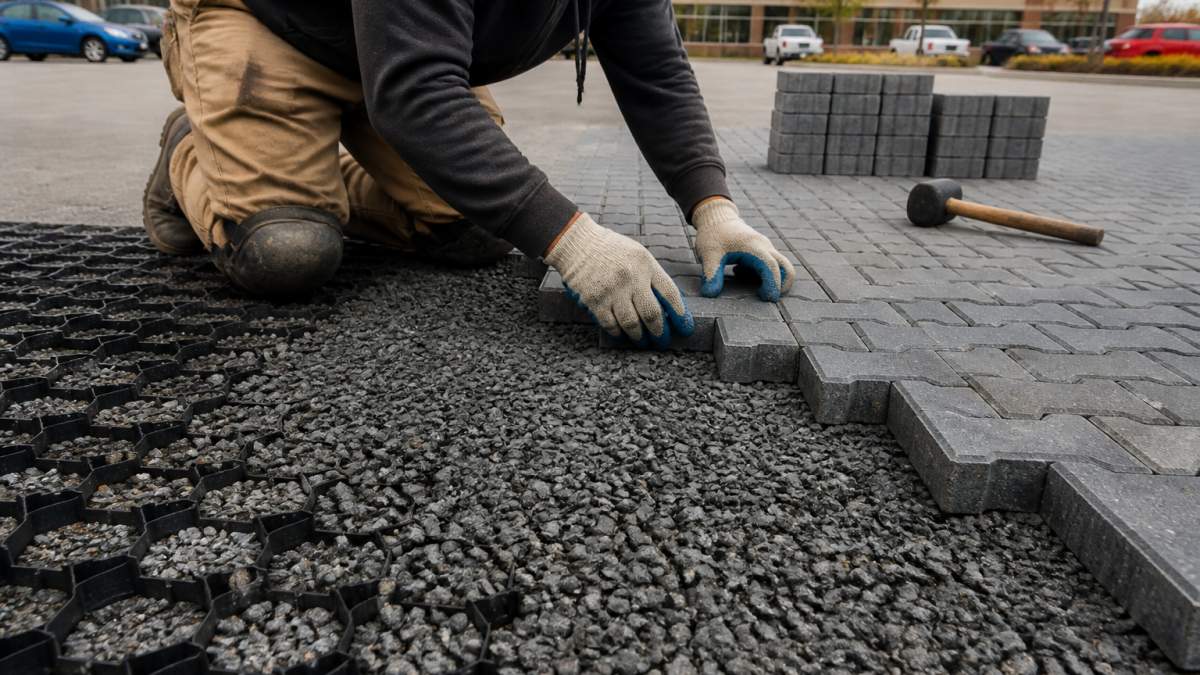
Because permeable pavers can help manage runoff where conventional surfaces shed water, the same principles inform permeable driveway solutions for sites exposed to heavy rain.
Which Systems Qualify as Open-Grid Paving
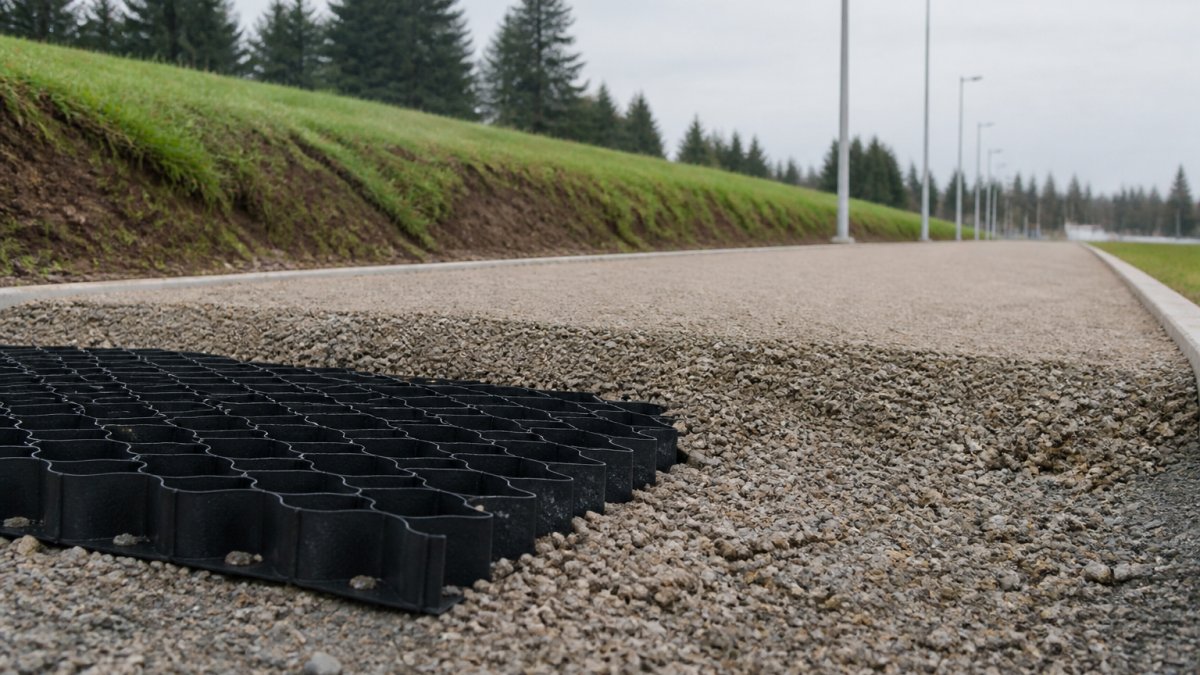
Open-grid paving requires a structure with substantial open area, typically a grid or cell filled with aggregate, soil, or turf. AirPave porous flexible paving is a geocell system in this category, with a sand-filled strength rating of 6,747 psi. See the AirPave Grass Fire Lane and Porous Flexible Paving page for grass paver fire lane and reinforced turf options. If your credit strategy depends on open-grid classification, confirm the product’s category before you write the spec.
LEED Certification Requirements and Documentation for Paving
LEED certification requirements and documentation for paving come down to three submittal elements: product data, recycled content verification, and the stormwater calculation. Missing any one of them stalls the credit.
Here is the workflow we recommend to project teams:
- Confirm the registered LEED version and the exact credit number
- Obtain third-party verification of recycled content, not a manufacturer letter
- Run the infiltration and storage calculation against the contributing drainage area
- Confirm the product’s paving classification against USGBC addenda
- Assemble the specification section with the correct CSI number
For porous flexible paving, the specification is CSI 32 12 43. A 32 12 43 AirPave specification for grass pave and turf reinforcement is the submittal-ready document to request.
Site Suitability: Soil, Climate, and Water Table Limits
Soil permeability, seasonal water table depth, and freeze-thaw exposure decide whether a porous system performs as designed. Clay-heavy subgrades infiltrate slowly and may need an underdrain. A high water table limits storage volume. In cold climates, saturated base courses raise frost heave risk.
A life-cycle cost and environmental assessment of porous pavement evaluated these environmental and economic tradeoffs using life-cycle analysis, which is the right frame: suitability is a site question, not a product question.
Permeable Pavers ADA Compliance and Surface Design
Permeable pavers ADA compliance hinges on surface stability, not permeability. The ADA Standards require accessible routes to be firm, stable, and slip resistant. An open-graded joint fill that migrates or deflects under wheelchair loads fails that test regardless of how well the system drains.
Specify joint aggregate gradation, compaction method, and a surface tolerance check at installation. Watch out: oversized joint openings are the most common cause of a failed accessibility review on permeable paver installations.
Porous Pavement Maintenance Schedule and Lifecycle Cost
A porous pavement maintenance schedule is the single biggest predictor of long-term performance, and it is the item most often cut from the budget. Sediment loading clogs surface voids; once infiltration drops, the credit’s stormwater performance claim no longer holds in practice. The mechanism is straightforward: fines, organic debris, and winter abrasives collect in the void structure, and without removal the infiltration rate falls until the system behaves like a conventional surface.
| Interval | Task | Consequence If Skipped |
|---|---|---|
| Monthly (first year) | Visual inspection of surface and joints | Clogging goes undetected |
| 2-3 times per year | Vacuum sweeping with regenerative air | Infiltration rate drops sharply |
| Annually | Infiltration rate test | Performance claims unverifiable |
| After leaf fall | Debris and sediment removal | Voids seal over winter |
| Every 5-10 years | Joint aggregate replenishment | Surface stability degrades |
Lifecycle cost is where the maintenance schedule meets the budget. Installation cost for permeable systems is often higher than conventional asphalt or concrete because of the open-graded base, geotextile, and underdrain components, and that premium is recovered only if the system keeps infiltrating. Routine vacuum sweeping and periodic infiltration testing are a major long-term cost, and a system that is never swept can require surface restoration far earlier than its design life. Building the sweeping and testing line items into the operating budget from day one is the difference between a system that performs for decades and one that is repaved early.
Performance monitoring closes the loop. An annual infiltration rate test gives the owner a documented trend, and that record supports both warranty conversations and any future credit or compliance claim. Where infiltration has dropped, regenerative air sweeping is the first remedy; if the decline persists, the base course may need inspection. Repairs to permeable systems are generally localized, joint aggregate replenishment and spot vacuuming, rather than full-depth replacement, which is why the maintenance budget matters more than the repair budget.
Why Some Porous Paving Strategies Fail to Qualify
Most failed submittals share one of four causes: the product was misclassified as open-grid paving, recycled content lacked third-party verification, the stormwater calculation used the wrong drainage area, or the system was specified on a subgrade that cannot infiltrate. None of these are product failures. They are documentation and suitability failures.
The USGBC addendum on porous asphalt and porous concrete is the clearest example. A team that submits either as open-grid paving gets a rejection, and the fix costs a resubmittal cycle.
Specifying a Recycled Geocell System for Your Next Project
A recycled geocell system simplifies the credit story because the material claim and the stormwater claim come from one product. AirField Systems manufactures AirDrain and AirPave from 100% recycled post-manufactured content, and both are made in America with patented quick connectors and a nesting design that reduces freight volume. AirPave carries a 6,747 psi sand-filled strength rating and has been installed on 600+ installations, with over 25 million square feet installed.
Frequently Asked Questions
Can porous paving help a project earn LEED credits?
Yes, in the right conditions. Porous paving most often supports stormwater management credits by reducing runoff volume and treating rainwater on site. It can also contribute to sustainable sites and materials credits when recycled content is documented. The U.S. Green Building Council notes that LEED does not set a single minimum imperviousness threshold for porous pavement across all Sustainable Sites credits, so the credit language for your specific rating system version decides whether your system qualifies.
Which LEED credits may apply to permeable pavement?
The main opportunities sit in stormwater management, where infiltration and runoff reduction are measured, and in sustainable materials, where recycled content and environmental product declarations count. Open-grid paving classifications matter too: USGBC addendum 5908 states that porous asphalt and porous concrete do not qualify as open-grid paving for the referenced credit. Confirm the exact credit language in LEED v4 or v5 before you specify, because the definitions differ between versions.
Are permeable pavers ADA compliant?
Permeable pavers can meet ADA requirements when the surface is firm, stable, and slip resistant, and when joints and openings stay within accessible design limits. Small joint widths and properly compacted base layers matter more than the paver material itself. Specify units with tight tolerances, verify slope and cross-slope, and confirm that the installed surface stays stable under foot and wheelchair traffic. Document the specification so your accessible route compliance is defensible at review.
What documentation is needed to support LEED credit claims for porous paving?
You will typically need manufacturer documentation for recycled content, environmental product declarations where claimed, and installation records confirming the base course and infiltration design. Stormwater credits require calculations showing runoff reduction and, in many cases, evidence the system performs as modeled. Keep third-party verification for recycled content on file, since consultants often ask for it directly. A practical credit calculation and documentation workflow should start at design, not at submission.
How should porous paving be maintained to preserve its performance?
A porous pavement maintenance schedule should include vacuum sweeping at least twice a year, more often under trees or near construction traffic, plus inspection after heavy storms. Keep the surface free of sediment, and avoid sand or fine debris that clogs infiltration. Inspect joints and open-graded areas for puddling, which signals clogging. Maintenance records also support long-term performance claims and help you defend the system’s modeled infiltration rate over the life of the project.
The gap between a porous paving spec that earns points and one that stalls in review is almost always documentation, not product performance. If your project team is mapping credits now, get the submittal package right the first time. Get started with AirField Systems and specify a 100% recycled geocell system with the credit documentation, strength data, and installation support your LEED submission needs.
