
Quick Summary
Geocell installation training for contractors should cover site assessment and subgrade preparation, geotextile placement, panel expansion and anchoring, connector seating, and quality checks at defined hold points. Crews should also learn how training differs for sports fields, roadways, slopes, and retaining walls. Good training prevents costly rework.
- Check the subgrade for soft spots, debris, and uneven grades before any panel arrives.
- Overlap geotextile seams to the specified width and keep the fabric free of wrinkles.
- Verify full cell expansion, anchor spacing, and connector seating before infill goes in.
- Set three hold points where the lead signs off before work continues.
- Measure infill depth at several points per panel rather than judging by eye.
Table of Contents
- What a Contractor Training Program for Geocell Installation Should Cover
- Geocell Installation Steps: Expanding, Positioning, Anchoring and Connecting Panels
- Geocell Installation Tools and Equipment Every Crew Should Carry
- Geocell Installation Checklist, Time Planning and Quality Acceptance
- Geocell Retaining Wall Installation: Training Differences by Application
- Schedule Your Crew’s Geocell Training With AirField Systems
- Frequently Asked Questions
What a Contractor Training Program for Geocell Installation Should Cover
Last Updated: November 19, 2026
Geocell installation training for contractors is more than a quick walkthrough of how panels snap together. A good program covers site conditions, material handling, and quality checks that prevent costly rework. Geocell track substructure support has been studied by federal researchers, whose findings show that these systems depend heavily on careful preparation and placement. Read realistic installation durations from a comparable golf course project to plan crew time.
Site Assessment and Subgrade Preparation
Every geocell project starts with the ground underneath it. Before a single panel comes off the truck, the crew should check the subgrade for soft spots, debris, and uneven grades.
Training should teach contractors to:
- Map existing drainage and utilities before excavation
- Measure subgrade elevations against the design plan
- Remove sharp rocks, roots, and debris that could puncture panels
- Confirm compaction meets the project specification
University of Texas at El Paso researchers found that geocell reinforcement significantly improves bearing capacity and reduces rutting and settlement in pavement design. Use of Geocell in Pavement Design final report on bearing capacity and rutting
Geotextile Placement and Panel Delivery
Many projects call for a geotextile separation layer between the subgrade and the geocell. The fabric keeps infill from migrating into soft soil below. Crews should learn to overlap fabric seams to the specified width and keep the fabric flat, without wrinkles that can telegraph through the finished surface.
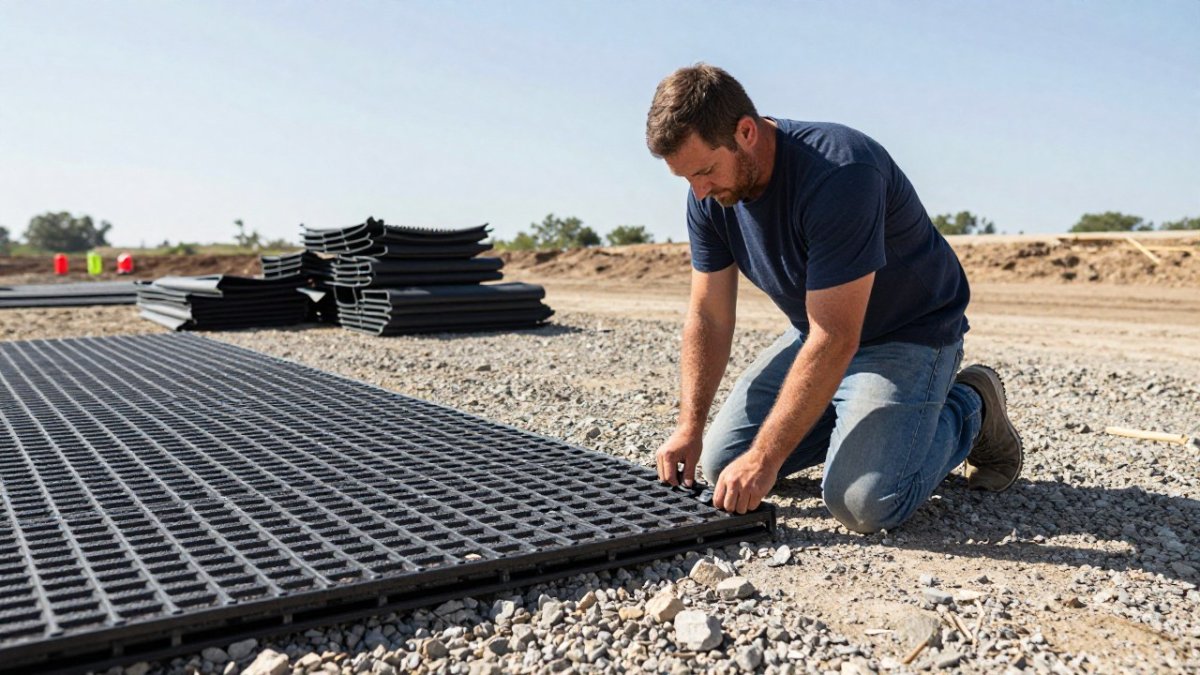
Panel delivery is the other half of this stage. Geocell panels ship as flat, collapsible strips, which makes them easier to stack and move on site.
Geocell Installation Steps: Expanding, Positioning, Anchoring and Connecting Panels
Once the subgrade and fabric are ready, the real work begins. The sequence below is a practical starting point for crew training.
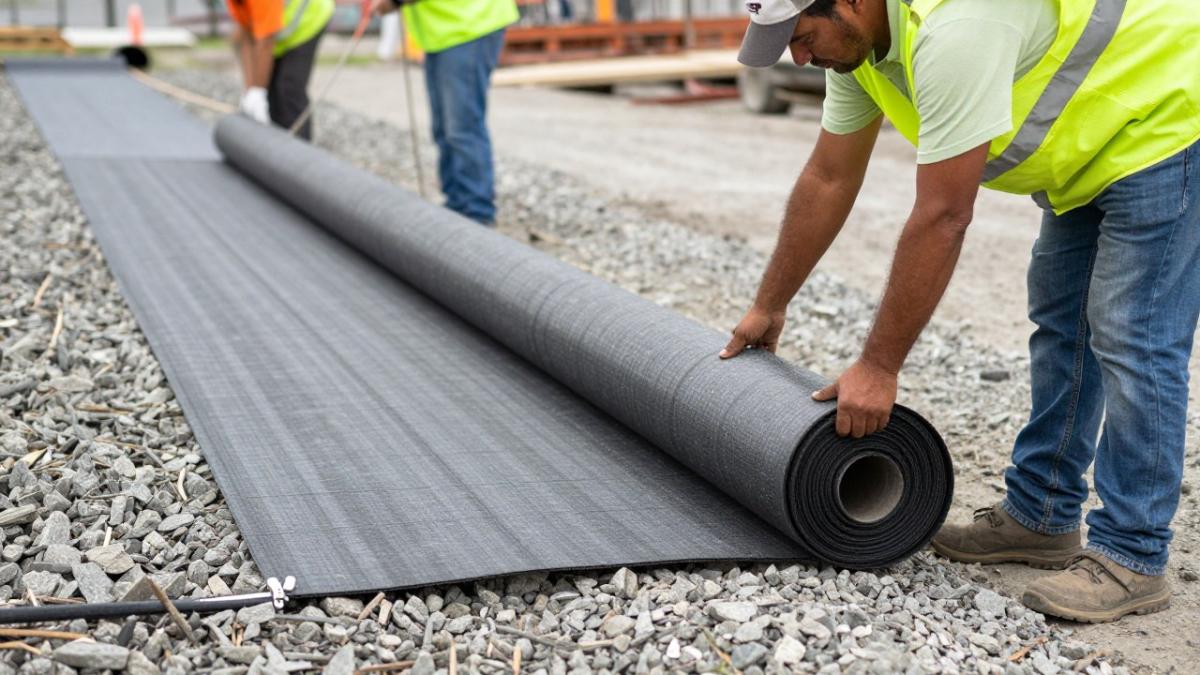
- Unroll the panel across the prepared area and check its orientation against the layout plan.
- Expand the cells by pulling the panel apart until the honeycomb shape locks into place.
- Position the section so edges line up with the marked boundaries.
- Anchor the panel with stakes or fasteners at the spacing the design calls for.
- Connect adjacent panels using the quick-connector system, checking that each joint seats fully.
- Inspect the seams before moving on to infill.
Each step has a common failure point. For the complete sequence on a sports field application, see the full step-by-step installation guide for sports fields.
Watch out: Panels that are not fully expanded before infill goes in will not carry load as designed, and fixing them later means lifting finished material.
Geocell Installation Tools and Equipment Every Crew Should Carry
A geocell crew is a small production line, and the tools and roles should be planned together. The list below separates what every crew carries from what scales with the job, and it assigns each item to a role so nothing is missing at the work face.
Core hand tools and consumables
- Stakes or anchors and the driver suited to them (sledge, post driver, or powered driver)
- Measuring tape, string line, marking paint, and a level or laser for grade checks
- Cutting tools rated for the panel material (HDPE cuts differently than softer polymers; use the tool the manufacturer specifies)
- Spare connectors and fasteners, counted against the panel count before unloading
- Hand tools for infill spreading and a rake or screed for strike-off
Equipment that scales with the job
- Small sports field or landscape job: hand tools, a plate compactor, and a small walk-behind spreader or wheelbarrow crew.
- Roadway, slope, or retaining wall: skid-steer or loader for infill, a vibratory roller or plate compactor matched to the infill, and enough staging area to keep panels and aggregate off the travel path.
- Slope work: additional anchoring equipment and safe access (ladders, temporary stairs, or graded access) planned before crews arrive.
Crew roles and staging
Assign roles before mobilization: a lead who owns the hold-point sign-offs, two to four panel handlers who expand and connect, an equipment operator for infill and compaction, and a laborer who keeps the face supplied. Stage panels flat and protected from weather and equipment traffic, keep infill stockpiles within safe carry distance, and mark the equipment travel path so loaded machines do not run over placed panels.
Productivity trade-offs to weigh
Machine infill placement raises hourly output but needs staging space and a safe travel path; hand placement suits tight sites but slows the schedule. Use this comparison of recycled and new geocell systems to weigh material options before committing to equipment. Learn how to source recycled geocell for sports fields.
Watch out: cutting panels with the wrong tool can leave ragged edges that fail to connect or anchor properly, so confirm the specified cutting method during training rather than improvising on site.
Geocell Installation Checklist, Time Planning and Quality Acceptance
A checklist only improves outcomes when each line item has a pass/fail test and a named person who signs off. Most training resources stop at “inspect the work”; a contractor-ready program converts inspection into hold points with measurable acceptance criteria and a short documentation trail.
Hold points and acceptance criteria
Set three hold points where work stops until the lead signs off. Treat the values below as starting points to confirm against the project drawings and the engineer’s specification, not as universal limits.
- Subgrade hold point. Verify grade within the tolerance shown on the drawings (commonly plus or minus 0.05 ft for pavement bases and tighter for sports surfaces), proof-roll or density-test per specification, and confirm no soft spots, debris, or standing water. Document with elevation shots and a photo log.
- Panel layout hold point. Confirm full cell expansion (cells open to the manufactured dimension, no partly collapsed honeycomb), anchor spacing matching the design, and every connector fully seated. Walk the perimeter and check panel edges against the marked boundaries before any infill.
- Post-compaction hold point. Check finished surface grade against design, confirm infill is flush to slightly proud of cell walls (not below), verify edge restraint, and inspect for bulging, rutting, or panel movement. Record density test results where the specification requires them.
A common pattern is to attach a one-page sign-off sheet to each shift’s work order: hold point, measured value, inspector initials, date, and photo reference. That sheet becomes the rework-prevention record if a question arises later.
Time planning and production factors
Production depends far more on site access and infill logistics than on panel handling. Build estimates from these factors rather than a single square-foot-per-day number:
- Area and shape. Long rectangular runs expand and anchor faster than irregular shapes with many cuts and connections.
- Site access and staging distance. Carry distance from the material drop to the work face drives labor hours; stage panels and infill as close to the face as safety allows.
- Crew size and roles. A lead, two to four panel handlers, an equipment operator, and a laborer on infill is a common minimum for machine-fed work; smaller crews suit hand-placed sports-field jobs.
- Infill method. Machine placement with a loader or conveyor moves far more volume per hour than wheelbarrow and shovel work.
- Weather and subgrade moisture. Wet subgrade can halt compaction and force rework; build weather buffer days into the schedule.
- Inspection time. Hold points consume schedule; plan them as tasks, not interruptions.
Build buffer days for rework. A missed expansion or anchor step found after infill costs far more time than one caught at the layout hold point, and the sign-off sheet is what makes that early catch routine.
Watch out: accepting a surface that looks even but has underfilled cells will pass a visual walk-through and fail under load, so measure infill depth at several points per panel rather than judging by eye.
The three hold points that stop work until the lead signs off, with the acceptance checks for each.
| Hold point | What to verify | Document with |
|---|---|---|
| Subgrade | Grade within drawing tolerance; no soft spots, debris or standing water | Elevation shots and photo log |
| Panel layout | Full cell expansion; anchor spacing per design; connectors fully seated | Walk-through of perimeter and joints |
| Post-compaction | Surface grade to design; infill flush to slightly proud; no bulging or movement | Density results where specified |
Geocell Retaining Wall Installation: Training Differences by Application
Retaining walls, slopes, and roadways each place different demands on a geocell system. A flat sports field mainly needs even surface support and good drainage. A retaining wall must resist lateral soil pressure, which changes how panels are anchored and how infill is compacted.
Training should therefore separate application types rather than teaching one generic procedure. A federal demonstration of geocell track substructure support showed that HDPE geocells can provide effective support while staying easy to transport as flat strips. Federal Railroad Administration field demonstration of geocell track substructure support Applying the same principle to each application is what separates a trained crew from one that is simply following steps.
Schedule Your Crew’s Geocell Training With AirField Systems
Strong training turns a geocell project from a risk into a dependable build. Crews that understand subgrade preparation, panel sequencing, anchoring, and quality checks deliver durable results on the first pass. Contact AirField Systems to plan training for your crew and to request a quote for your project. Quantity, delivery dates, and site requirements all affect cost, so a direct conversation gives you the most accurate answer.
Frequently Asked Questions
How do contractors install geocells?
Contractors install geocells by preparing and grading the subgrade, placing a geotextile separation layer, unrolling and expanding panels, positioning and aligning them, anchoring with stakes or fasteners, connecting adjacent panels, and filling the cells with compacted infill. Training should walk crews through each sequence in order, because skipped steps, such as failing to anchor before filling, are a common source of misaligned cells and rework. Manufacturer installation guidance and field demonstrations are useful starting points for building a repeatable procedure.
What tools are needed to install geocells?
A typical geocell crew needs stakes or fasteners, a means of connecting panels, measuring and alignment tools, compaction equipment suited to the infill, and loading equipment for placing fill. Exact requirements depend on panel size, infill type and site conditions, so the specification and the manufacturer’s installation guidance should set the final equipment list. Training should include a tool checklist so crews confirm equipment is on site before panel delivery begins.
Is geocell installation training available for contractors?
Yes. Contractors can also build an internal training program around a written installation sequence, a pre-pour checklist and supervised first installations. AirField Systems offers installation guidance for its products; contact the company directly for current training options and availability.
