
Quick Summary
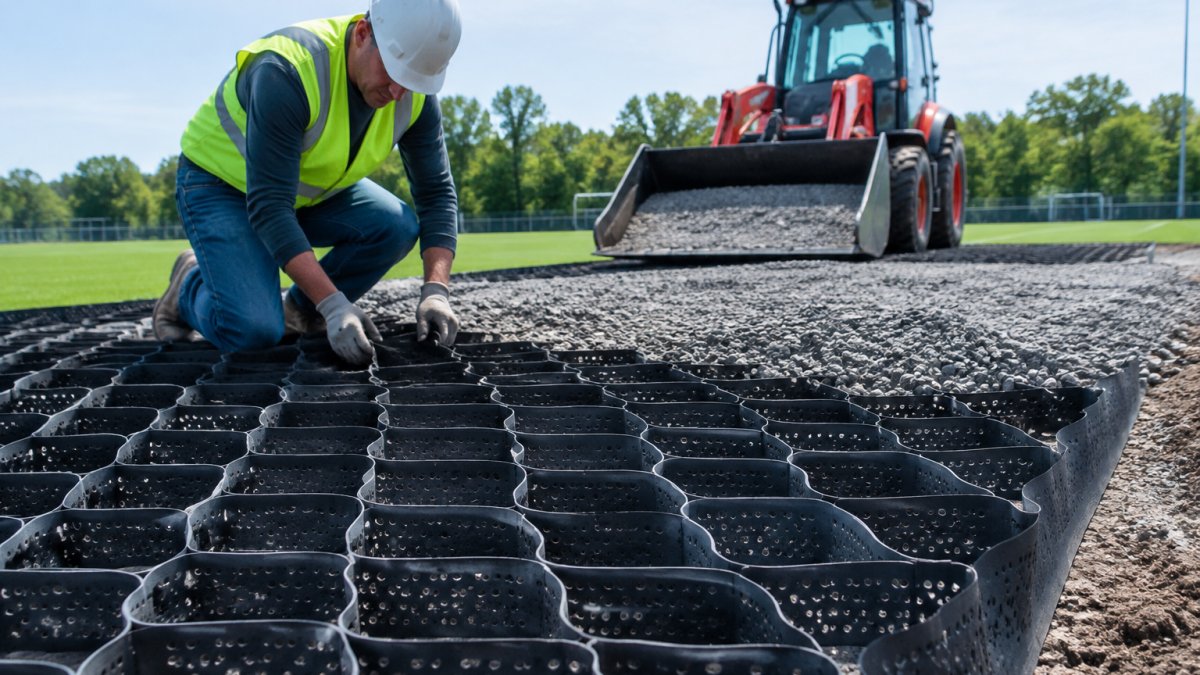
Geocell installation for sports fields begins with preparing a clean, level subgrade, then unfolding and anchoring the panels, filling the cells in lifts, and planning drainage. A well-prepared base lets the cells lock in and carry player traffic evenly.
- Clear the site of roots, rocks, and debris before anything else.
- Excavate to the depth your design calls for.
- Compact the subgrade and check grades with a laser or string line.
- Lay geotextile fabric to separate the subgrade from the infill.
- Anchor panels with stakes at the edges and across the field.
Table of Contents
- Preparing the Subgrade and Site for Geocell Installation
- Unfolding, Connecting, and Anchoring Geocell Panels
- Filling the Cells and Planning Your Geocell Drainage System for Sports Fields
- Frequently Asked Questions
Preparing the Subgrade and Site for Geocell Installation
Last Updated: November 12, 2026
Geocell installation for sports fields starts long before the first panel is unrolled. The base decides how well the whole field performs. A clean, level subgrade lets the cells lock in and carry load evenly.
- Clear the site of roots, rocks, and debris.
- Excavate to the depth your design calls for.
- Compact the subgrade and check grades with a laser or string line.
- Lay a geotextile fabric to separate the subgrade from the infill.
Uneven subgrade can create soft spots under player traffic.
The article lists four preparation steps that come before any panels are laid.
| Step | What to do | Note |
|---|---|---|
| Clear the site | Remove roots, rocks, and debris | Start with a clean base |
| Excavate | Dig to the depth your design calls for | Depth set by design |
| Compact and grade | Compact subgrade and check grades with laser or string line | Uneven subgrade causes soft spots |
| Lay geotextile | Separate subgrade from infill with fabric | Keeps infill from mixing with subgrade |
Unfolding, Connecting, and Anchoring Geocell Panels
Geocell panels arrive folded and nest for shipping. Unfold them across the prepared area, then connect neighboring panels using the quick connectors. Work in straight rows so the cell pattern stays consistent across the field. Once the rows are aligned, keep the surface even and secure, a useful foundation when installing artificial turf on a slope.
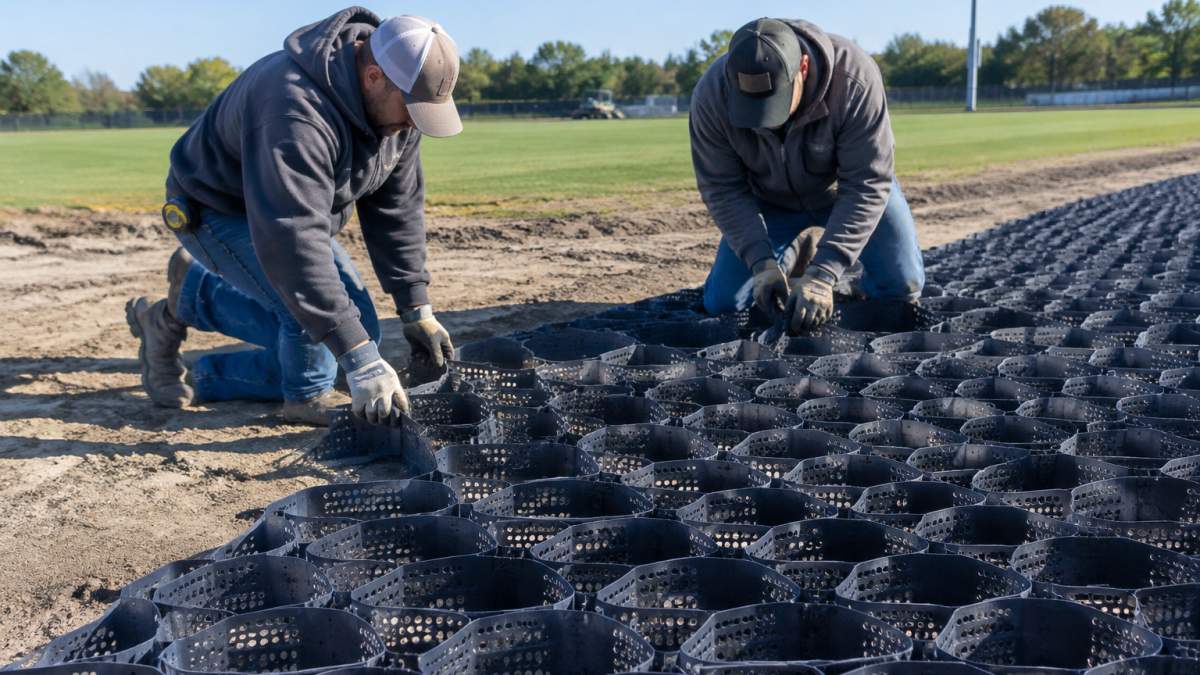
Anchor the panels with stakes at the edges and at intervals across the field. This keeps the cells from shifting before infill goes in.
Filling the Cells and Planning Your Geocell Drainage System for Sports Fields
Fill the cells with a granular material that drains well and resists compaction. Use the material your design specifies, and fill in lifts so each layer compacts evenly. Drainage planning for sports fields should cover outlet locations and slope so surface water moves off the field.
Pricing depends on quantity, dates, and delivery. Contact AirField Systems for current prices or a quote based on your project size and schedule. For more detail, see how to buy recycled geocell for sports fields and how long geocell installation takes on a golf course.
Frequently Asked Questions
Can you fill geocell with concrete?
Geocells are usually filled with compacted aggregate, sand, or soil rather than concrete. Concrete makes the cells rigid and removes the flexibility that lets the system distribute load and drain water. For sports fields, a well-graded crushed stone or sand infill is the standard choice, and fill selection should follow the drainage and playing-surface specifications for the project. Check with AirField Systems for guidance on the infill that matches your field design.
How long does a professional geocell installation take for a standard sports field?
Timing depends on field size, subgrade condition, weather, crew size, and how much excavation and grading is needed. Because pricing and schedules depend on quantity, dates, and delivery, request a project-specific timeline from AirField Systems rather than relying on a general estimate. Plan extra time for subgrade preparation, since a poorly prepared base can cause delays and later problems.
What is the difference between geocell and geogrid for ground stabilization?
Geocell is a three-dimensional honeycomb that confines infill in all directions, while geogrid is a flat, two-dimensional grid that reinforces soil in a plane. Geocell is generally better suited to sports fields where confinement and drainage matter, because the infilled cells hold their shape under repeated foot traffic and allow water to move vertically through the system.
