
Last Updated: November 21, 2026
Quick Summary
The four specifications that decide whether geocell grids will hold your load are cell depth, wall thickness, panel size and infill strength rating. Driveways and fire lanes generally need deeper cells, typically 3 to 8 inches, and a stronger base. Compare quotes per expanded square foot, not per panel.
- Driveways and fire lanes generally need 3-8 inch cells; shallow 2-inch cells suit pedestrian areas.
- HDPE geocell walls typically run from about 50 mil to 100 mil in thickness.
- Ask suppliers for a test report stating the standard, infill type and load measurement method.
- Divide quoted prices by expanded square footage, not the collapsed shipping footprint, to compare costs.
- A low per-panel price with shallow cells may need a thicker aggregate base, erasing the savings.
Table of Contents
- What to Check Before You Buy High-Strength Geocell Grids
- Geocell Ground Grid for Driveway and Slope Protection Projects
- Geocell vs Geogrid: Which Reinforcement Fits Your Project
- Geocell Ground Grid Cost and Total Installed Value
- Frequently Asked Questions
What to Check Before You Buy High-Strength Geocell Grids
Buying high-strength geocell grids starts with specifications, not price. Four numbers decide whether a grid will hold your load: cell depth, wall thickness, panel size and infill strength rating.
Cell depth. Most high-strength geocell for vehicular use falls in the 3-inch to 8-inch range, with 4-inch and 6-inch depths covering most driveway, access-road and fire-lane projects. Shallow 2-inch cells suit pedestrian, pet and turf-protection areas. Deeper cells confine more infill and spread wheel loads further, but require more infill volume.
Wall thickness and strip strength. HDPE geocell is typically extruded in wall thicknesses from about 50 mil to 100 mil (roughly 1.2 mm to 2.5 mm). Thicker walls resist seam peel and hoop stress better under repeated loads. Ask for seam peel strength and cell wall tensile strength, not just a marketing “high strength” label.
Panel size and coverage. Panels are commonly sold in expanded dimensions such as 8 ft x 20 ft or 8 ft x 24 ft, yielding roughly 160 to 200 square feet per panel. Confirm whether the quoted price covers expanded coverage or the collapsed shipping footprint, the difference changes your cost per square foot.
Material and recycled content. Most geocell ground grids are made from high-density polyethylene (HDPE), and recycled content varies by manufacturer. AirField Systems describes its AirDrain and AirPave products as made from 100% recycled post-manufactured content, which is worth verifying against the documentation you receive.
How to verify a strength claim. Listings routinely cite load capacity or “high strength” without stating the test method or infill used. Request the test report and check the test standard cited, whether the infill was sand, gravel or a specified aggregate, and whether the result is a single-point peak or a sustained-load value. A rating measured with angular gravel is not directly comparable to one measured with rounded sand. If a supplier cannot produce the report, treat the number as a claim rather than a specification.
Match the cell depth to your traffic. Shallow cells suit light pedestrian or pet areas. Driveways and fire lanes generally need deeper cells and a stronger base. A useful check: U.S. Department of Transportation guidance on pavement base design sets the baseline for how subgrade conditions affect load capacity.
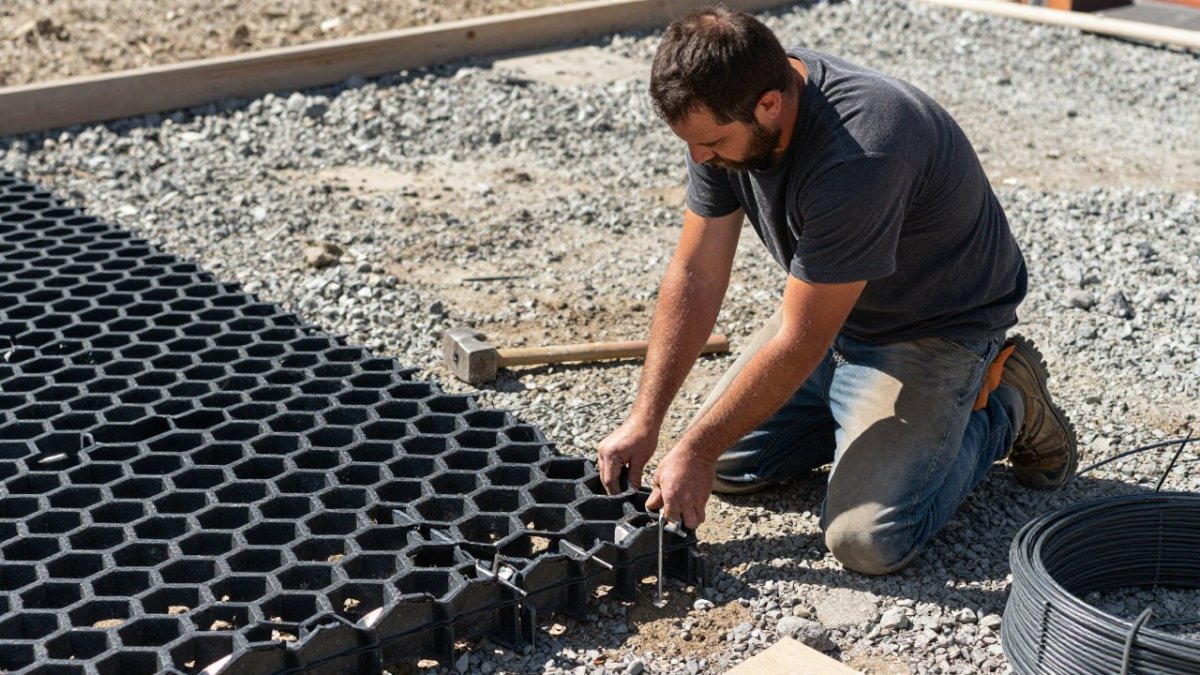
Connection and shipping. Patented quick connectors speed assembly, and nesting designs reduce freight volume. Both affect your labor and delivery costs as much as the product price. Ask for the collapsed pallet footprint and the connector type before you compare quotes.
The four numbers that decide whether a grid will hold your load are summarised below.
| Spec | Typical range in article | Why it matters |
|---|---|---|
| Cell depth | 2 to 8 inches | Deeper cells spread wheel loads but need more infill |
| Wall thickness | About 50 to 100 mil | Thicker walls resist seam peel and hoop stress |
| Panel size | 8 ft x 20 ft or 8 ft x 24 ft | Confirm whether price covers expanded coverage |
| Infill strength rating | Varies by test method | Angular gravel and rounded sand are not directly comparable |
Geocell Ground Grid for Driveway and Slope Protection Projects
Geocell ground grids work well on driveways because the honeycomb walls confine the infill and spread wheel loads across a wider area, limiting rutting and keeping the surface stable.
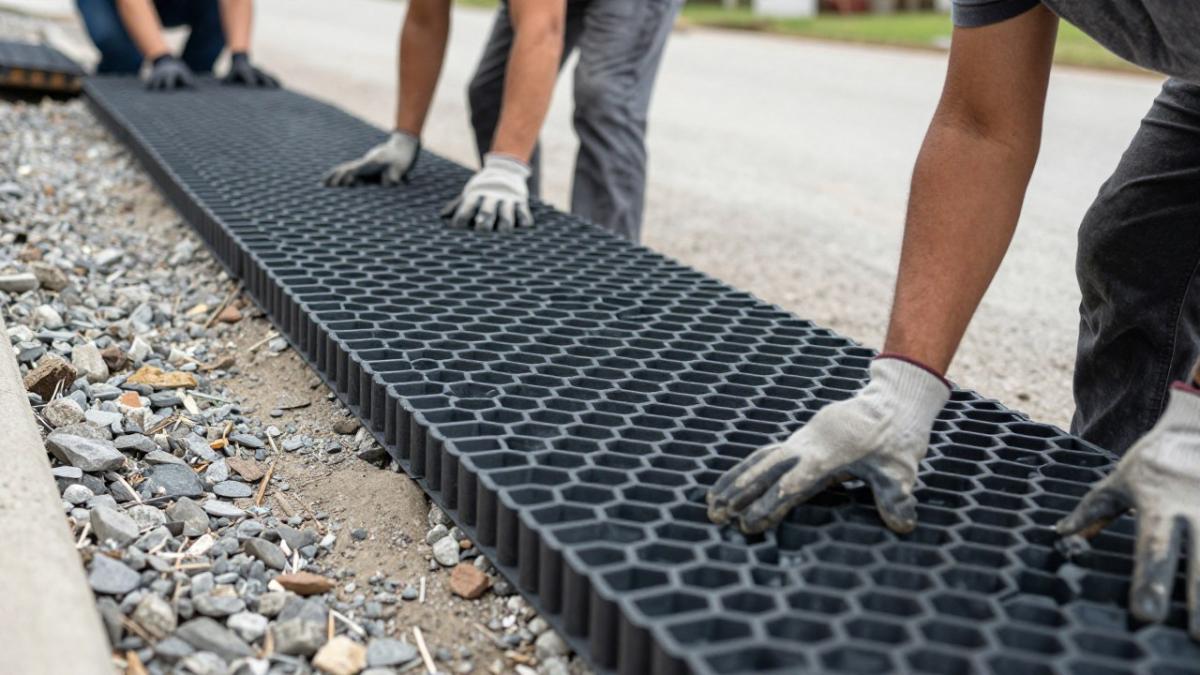
For slopes, the same confinement holds soil and gravel in place. Erosion control on steep ground depends on cell depth and infill compaction; grids too shallow for the slope let infill migrate downhill.
A common mistake is treating a driveway and a slope as the same job. Driveways need load-bearing strength under repeated vehicle traffic; slopes need anchoring and drainage. Specify each separately, even on one project. Field-level installation training for geocell driveway and slope work walks through the installation steps for each.
Geocell vs Geogrid: Which Reinforcement Fits Your Project
Geocell and geogrid both reinforce soil, but they work differently. Geocell creates a three-dimensional cellular structure that holds infill in all directions. Geogrid is a flat, two-dimensional mesh that reinforces the soil layer it sits in.
For roads, parking areas and heavy point loads, geocell usually gives better confinement. A complete guide to porous paving options for parking-type loads compares the surface alternatives in more depth. For a thin reinforcement layer over soft subgrade, geogrid can be the simpler choice. Soil type, traffic and base depth decide the right option.
Geocell Ground Grid Cost and Total Installed Value
Pricing depends on quantity, cell dimensions, delivery location and installation scope. Learn how to buy recycled geocell for sports fields at a sensible price. For a current quote, contact AirField Systems directly or visit its website. Before you call, build a total installed cost model, the panel price is rarely the largest line item.
Normalize to cost per square foot. Suppliers quote per panel, per pallet or per project, and expanded coverage differs by product. Divide the quoted price by the expanded square footage, not the collapsed shipping footprint, to get a comparable number. A cheaper panel per unit can cost more per covered square foot.
Build the installed-cost stack. A realistic total includes:
- Geocell panels at the quoted expanded coverage rate
- Infill aggregate or soil, priced per cubic yard and converted to the cell volume you need (deeper cells consume more infill per square foot)
- Subgrade preparation, excavation, grading and compaction
- Anchoring hardware, stakes or tendons, especially on slopes
- Labor for expansion, connection, infill placement and compaction
- Freight, which depends on collapsed pallet volume and distance
- Equipment rental for compaction or material handling
Where the money actually moves. Infill and subgrade preparation usually dominate installed cost on driveway and access-road projects, since both scale with cell depth and site conditions. Freight is most sensitive to product design: nesting and collapsed-panel designs reduce pallet volume, and quick connectors cut assembly labor. On a tight schedule, labor savings from faster connection can outweigh a higher panel price.
Compare bids on the same basis. Ask every supplier for the same five figures: expanded coverage per panel, wall thickness, cell depth, collapsed pallet footprint and the test report behind the load claim. Then price infill and subgrade work separately using your own site quantities. Bids built on different infill assumptions or coverage definitions are not comparable.
Watch out: a low per-panel quote paired with a shallow cell depth can require a thicker aggregate base to reach the same load capacity, erasing the apparent savings.
Ready to compare specifications for your project? Browse geocell and AirDrain products to see the categories available, or read our guide to choosing recycled geocell systems before you decide.
Frequently Asked Questions
Is geocell worth it for a gravel driveway?
For many gravel driveways, geocell is worth considering because the three-dimensional cells confine infill and spread vehicle loads across a wider area, which helps reduce rutting and gravel migration. Its value depends on soil strength, expected vehicle traffic and cell depth. Compare the installed cost against the amount of base material you would otherwise need and the maintenance you would avoid. For light residential use the benefit is often smaller, so review the project’s specific load and soil conditions before deciding. Ask your supplier for the product’s load ratings and recommended depth for your conditions.
What should I compare when choosing a geocell supplier?
Start with the specifications: HDPE material, cell depth, panel dimensions and the load-bearing data the supplier publishes. Ask whether strength figures come from independent or third-party testing and what conditions the tests used. Confirm the warranty, return policy and technical support available during installation. Compare pricing on a per-square-foot basis and ask about bulk discounts and shipping costs to your site. Current pricing depends on quantity, delivery and project details, so request a formal quote from AirField Systems on its website for accurate figures.
Where can I buy high-strength geocell grids?
High-strength geocell grids are sold directly by manufacturers and through distributors and civil supply vendors. When you buy, confirm the material is virgin HDPE, that the cell depth and panel size match your design, and that the product’s strength ratings are documented. Ask about nesting and packaging to reduce freight costs on larger orders. For current availability, specifications and pricing, visit the AirField Systems website or request a quote directly, since prices vary with quantity, dates and delivery location.
