
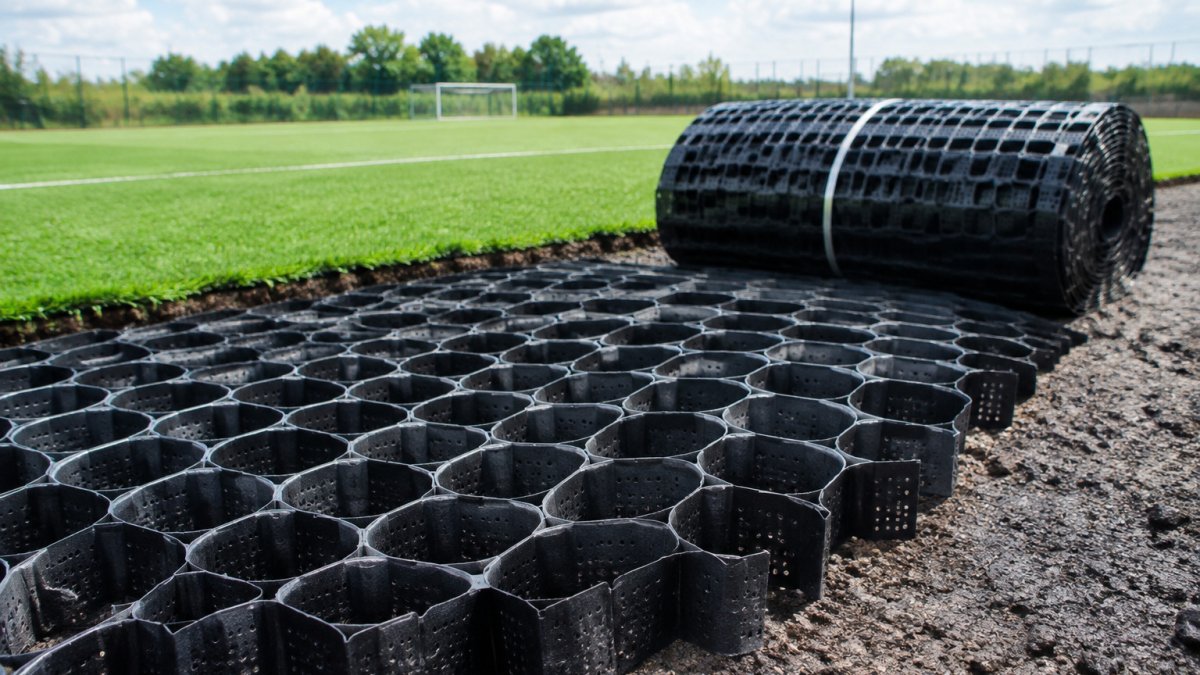
Quick Summary
A recycled geocell is a honeycomb grid, usually made from recycled polyethylene, that holds infill in place and spreads load across the base layer of a sports field. Buyers should match cell depth, panel size and fill material to the field’s use, and verify any recycled content claim with documentation before ordering.
- Common starting point for turf subbases is a 3-inch to 4-inch cell, not a fixed rule.
- Use angular crushed gravel in the 3/4-inch to 1-1/2-inch range as structural fill, per the article.
- Rounded river rock and uniform sand fill can migrate out of the cells under traffic.
- Recycled content is not one standard, so request the recycled percentage and third-party verification in writing.
- Compare installed cost per square foot and lifecycle cost, not just the per-panel price.
Table of Contents
- What Recycled Geocell Does on a Sports Field
- Geocell Selection Guide: Cell Depth, Dimensions and Fill Material
- Verifying Recycled Content and End-of-Life Claims
- Geocell Installation for Sports Fields: Base Prep, Infill and Timeline
- Evaluating Recycled Geocell Suppliers and Requesting a Quote
- Frequently Asked Questions
What Recycled Geocell Does on a Sports Field
Last Updated: November 5, 2026
If you are buying recycled geocell for a sports field, the first question is what the product actually does underground. A geocell is a three-dimensional honeycomb grid, usually made from recycled polyethylene, that holds infill material in place and spreads load across the base layer.
Most buyers focus on the recycled label first. That makes sense, but it is only one part of the decision. The grid’s cell depth, its panel dimensions, and the fill you pour into it will determine how the surface performs over time.
Geocell systems are typically used for ground stabilization, erosion control on slopes, and drainage channels. Research on reinforced base layers, including a 2017 University of Texas at Arlington thesis on geocell-reinforced recycled asphalt base layers, supports the general principle that confinement improves the behavior of granular and recycled materials under repeated load.
Geocell Selection Guide: Cell Depth, Dimensions and Fill Material
Selection starts with three variables: cell depth, panel size, and fill type. On a sports field, those variables are not abstract, they translate directly into surface firmness, ball bounce consistency, drainage rate, and how the field holds up under cleats and maintenance equipment. Most general geocell guides stop at dimensions; a field buyer needs the performance link.
Cell depth controls how much fill the grid holds and how far load spreads into the base. Deeper cells generally add confinement and load distribution, but they also raise infill volume, hauling, and installation cost.
Matching Cell Depth to Field Performance
A common pattern on athletic-field base layers is a 3-inch to 4-inch cell for natural-turf and synthetic-turf subbases, with 2-inch cells used on light-duty or secondary surfaces and 4-inch to 6-inch cells reserved for heavy-load or high-traffic areas.
Surface firmness is the performance criterion buyers feel first. A deeper cell with a well-graded angular infill produces a firmer, more predictable footing; a shallow cell with rounded or poorly graded fill can shear and rut under repeated cleat loading.
Drainage is the second criterion. The cell itself does not drain, the infill and the base beneath it do.
Fill Material Selection for Sports Fields
Pick the fill based on drainage and surface needs, not habit. Angular crushed gravel in the 3/4-inch to 1-1/2-inch range locks well inside the cells and is the most common structural fill for field subbases. Sand-based infill suits some synthetic-turf systems but needs careful grading and a separation layer to prevent migration.
Watch out: rounded river rock and uniform sand fill can migrate out of the cells under cleat traffic and rain, leaving the grid exposed and the surface uneven. Confirm with the supplier which fills the product is rated for, and ask for the recommended gradation in writing before you commit.
Why the 3-Inch Geocell Ground Grid Is Common for Turf Applications
The 3-inch geocell ground grid is a common starting point for turf work because it balances confinement with a manageable profile.
Shallower grids can be sufficient for light-duty surfaces, while heavier-use fields may call for deeper cells. Ask your engineer or supplier to confirm the depth against your specific load and drainage requirements instead of defaulting to any single size.
The table below summarises the typical cell depth ranges and fill options the article describes for sports-field geocell.
| Item | Typical use | Key note |
|---|---|---|
| 2-inch cell | Light-duty or secondary surfaces | Shallow profile, less confinement |
| 3-inch to 4-inch cell | Natural and synthetic turf subbases | Common starting point, not a rule |
| 4-inch to 6-inch cell | Heavy-load or high-traffic areas | Adds infill volume and cost |
| Angular crushed gravel (3/4″ to 1-1/2″) | Structural subbase fill | Locks well inside the cells |
| Sand-based infill | Some synthetic-turf systems | Needs grading and a separation layer |
| Topsoil or engineered soil mix | Under natural turf | Rootzone must stay agronomically functional |
| Rounded river rock or uniform sand | Not recommended | Can migrate out of the cells under traffic |
Verifying Recycled Content and End-of-Life Claims
“Recycled” is not a single standard, and many buyers discover too late that the claim covers less than they assumed. Some geocell listings describe recycled polyethylene, while others use virgin high-density polyethylene.
Check the supplier’s documentation for the percentage of recycled content, the source of that material, and any third-party verification. For projects pursuing green building credits, a claim you cannot document is a risk.
End-of-life is the other half of the claim. Ask what happens to the product after its service life and whether the supplier offers a take-back or recycling pathway.
For turf environments, the EPA and CDC have published research on recycled tire crumb rubber infill, which is a different material. See the EPA synthetic turf field recycled tire crumb rubber research for context on that material.
Geocell Installation for Sports Fields: Base Prep, Infill and Timeline
Installation quality decides whether the system performs as designed. A crew laying geocell panels over a graded base, with gravel stacked beside them, is a familiar sight on these projects.
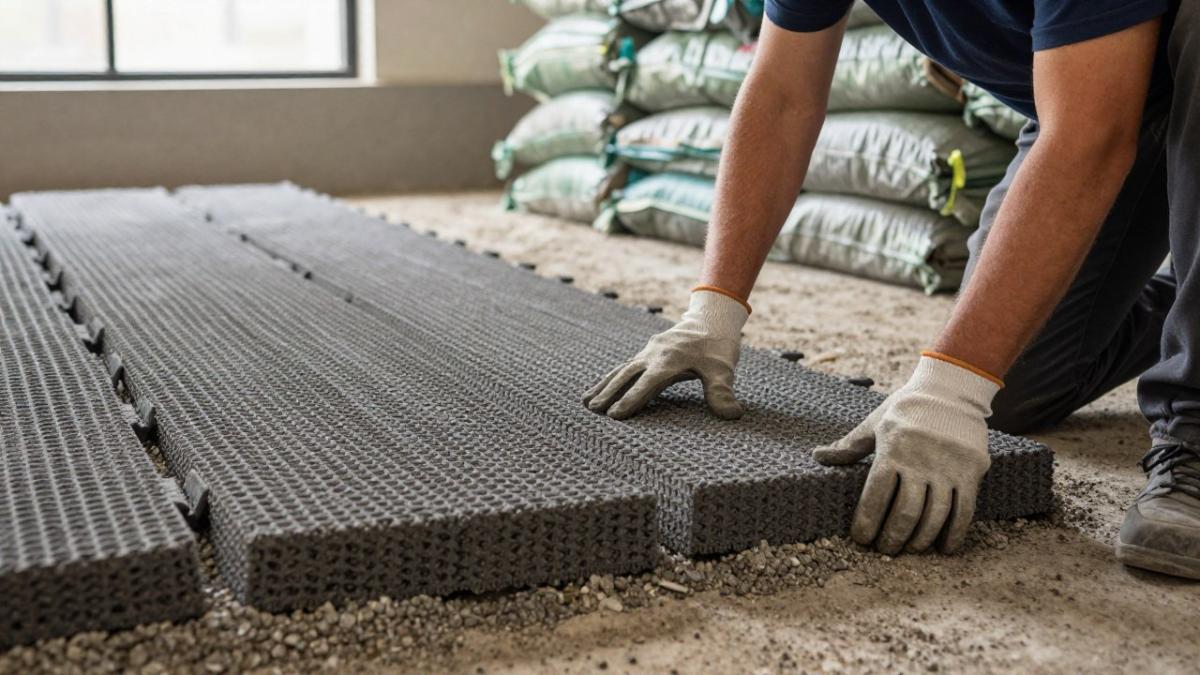
Plan the timeline around base preparation first. Grading and compaction take longer than most schedules allow for, and rushing them undermines the rest of the build. Infill placement and final surfacing follow once the grid is secure.
A common mistake is treating the geocell as a surface product rather than a structural layer. The grid works only when the base beneath it and the infill above it are designed together.
Evaluating Recycled Geocell Suppliers and Requesting a Quote
When you compare suppliers, look beyond unit price. A geocell quote that lists only a per-panel price is not comparable to another supplier’s quote, because the material is only part of the installed cost. Ask every supplier for the same package of information so you can compare on equal terms.
The Documentation Checklist
Request the recycled-content documentation first: the percentage of post-consumer or post-industrial recycled material, the source of that material, and any third-party verification or test reports. “Recycled” is not a single standard, and a claim you cannot document is a procurement risk if your project needs certification or green-building credit support.
Next, request load and performance data: cell depth and wall thickness, seam strength, perforation pattern (perforated cells drain and root better; solid cells suit some structural applications), and any independent test results for load capacity and durability.
Installed Cost and Lifecycle Cost
A field project budget needs the installed cost, not only the per-panel price. A comparable project-level estimate includes:
- Geocell material (panel count based on field area plus a 5-10% overlap and waste allowance)
- Infill material and hauling (gravel, sand, or engineered soil, priced by ton or cubic yard)
- Base preparation, grading, compaction, and any subgrade improvement
- Labor for panel layout, seam connection, anchoring, and infill placement in lifts
- Drainage components and surface finishing
- Maintenance and replacement over the service life
Pricing depends on quantity, delivery location, and project timing. Request a quote and specification sheet from AirField Systems to compare accurately against other options you are considering. When the quotes come back, normalize them to a cost per square foot of installed field and a lifecycle cost that accounts for expected maintenance and replacement, that is the number that actually decides the project.
Comparing Suppliers Side by Side
Use the same scorecard for every supplier: verified recycled content, documented load and drainage performance, field-specific installation guidance, warranty terms, and installed cost per square foot. A supplier who provides installation guidance or a written fill sequence is reducing your risk, and that has value beyond the panel price.
AirField Systems offers the AirDrain drainage system, and you can review the product details on our AirDrain for synthetic grass drainage and shockpad page before requesting pricing. For natural grass projects, our sports field drainage page explains how the system works with natural and synthetic turf, and the AirDrain agronomic natural grass installation page covers natural turf field installations. The AirDrain natural grass drainage white paper summarizes research on the system.
Frequently Asked Questions
Where can I buy recycled geocell for sports fields?
Recycled geocell is sold by manufacturers and by distributors that stock ground-reinforcement products. Because not every geocell is recycled, ask each supplier for the recycled content of the specific product you are considering, not just the brand. Pricing depends on quantity, delivery location and dates, so request a written quote from the supplier. AirField Systems can provide a quote for your project.
What should I compare when buying geocell for a sports field?
Compare cell depth, panel dimensions, wall material and thickness, fill compatibility, and the load the grid is rated to carry. Confirm whether the product is perforated or solid, since that affects drainage and fill retention. Ask for the recycled content in writing and whether it is post-manufactured. Also compare freight cost per square foot covered, because nesting designs can change how many panels fit on a truck.
Is geocell ground grid suitable for sports fields?
Geocell ground grid is used to reinforce base layers and confine infill on sports fields, helping spread loads and stabilize soft ground. Its suitability depends on the field type, the subgrade, and the fill material. Independent testing data and a documented installation approach matter more than general claims. Ask the supplier for test results relevant to your field use before committing to a system.
How do I verify that a geocell product is made from recycled material?
Ask the supplier for documentation that states the recycled content percentage and whether it is pre-consumer or post-manufactured material. Request a third-party certification or test report where available, since LEED documentation often requires one. Confirm the claim applies to the exact product model you are buying, not a related line. AirField Systems states its products are 100% recycled post-manufactured content.
