
Last Updated: October 31, 2026
Quick Summary
Reducing shipping costs for drainage starts with planning: calculate your total freight cost per square foot, use the freight class, dimensions and weight of your pallets when requesting quotes, and choose LTL, FTL or dedicated freight based on order size and product shape. Shipping costs for drainage also drop when panels nest densely, phases are consolidated, and jobsite access is confirmed before delivery.
- Divide your total freight quote by the delivered square footage to compare suppliers on a cost per square foot basis.
- Each AirDrain pallet holds 114 parts, covers 798 square feet and weighs about 395 pounds.
- Compare modes on total landed cost, including liftgate, limited-access and redelivery fees, not just the base rate.
- Consolidate project phases into fewer, fuller loads to reduce the number of deliveries and handling events.
- Confirm dock access, gate hours and whether a liftgate is needed before booking any delivery.
Table of Contents
- Why Freight Is a Large Share of Drainage Project Costs
- Step 1: Calculate Your Shipping Costs for Geocell Products
- Step 2: Choose Between LTL vs FTL Shipping for Drainage Systems
- Step 3: Use Nesting Design and Pallet Density to Cut Freight
- Step 4: Plan Consolidated Deliveries and Jobsite Access
- Requesting a Freight Quote for Your Next Drainage Project
- Frequently Asked Questions
Freight is often one of the largest line items on a drainage project, and shipping costs for drainage are frequently underbudgeted. A geocell drainage system is light for its volume, but the panels are bulky, and a delivery that looks cheap on paper can climb once dimensions, jobsite access and carrier fees are added. This guide walks through the practical levers that reduce those costs, using AirField Systems products as the working example.
Why Freight Is a Large Share of Drainage Project Costs
Shipping is rarely a small detail. Bulk products that take up a lot of truck space can cost more to move than their weight would suggest.
Three factors drive most of the cost:
- Volume: Bulky panels fill trailers quickly, even when they are light.
- Distance and mode: The farther a load travels, and the more carriers it passes through, the higher the bill.
- Delivery conditions: Tight jobsites, lift-gate needs and scheduling changes add fees.
The Federal Highway Administration’s fourth-edition HEC-22 manual covers the design of storm drainage systems tied to transportation facilities, which is useful context when planning the layout that drives your order size (FHWA HEC-22 Urban Drainage Design manual).
Step 1: Calculate Your Shipping Costs for Geocell Products
Start by building a simple cost model before you request any quote. Carriers generally price on the freight class, weight and dimensions of the load, so gather those numbers first. Watch the AirDrain video on why the system is shipping-efficient.
What to collect:
- Total square footage of the installation
- Panel count and pallet count for the order
- Pallet dimensions and total weight
For a quick estimate, divide your total freight quote by the square footage delivered. That gives you a cost per square foot you can compare across suppliers and options.
Pricing depends on quantity, delivery dates and destination, so request a formal quote from AirField Systems to see current shipping costs for drainage on your project. See how installation timing affects delivery scheduling.
Freight Class, Dimensional Weight and Oversize Charges
Freight class and dimensional weight both affect what you pay. Bulky, low-density products can be billed on their size rather than their actual weight. Oversize charges can apply when a pallet or panel exceeds standard carrier dimensions.
- Freight class: Determines the base rate for LTL shipments.
- Dimensional weight: Billing based on volume when a load is bulky but light.
- Oversize fees: Extra charges for items that exceed standard limits.
Ask your carrier how they calculate billable weight for your specific pallets. A short conversation at the quoting stage can prevent a surprise on the invoice.
Step 2: Choose Between LTL vs FTL Shipping for Drainage Systems
LTL (less-than-truckload) and FTL (full truckload) are the two main options, but the right choice for a drainage order depends less on total weight than on how the product’s dimensions, the jobsite’s access, and the construction schedule interact. A load that is cheap per pound can still be expensive per square foot if it triggers rehandling, liftgate fees, or a failed delivery.
A decision framework for drainage orders
Use order size, product dimensions, delivery urgency, and total landed cost, not just the line-haul rate, to pick a mode.
| Situation | Likely best mode | Why |
|---|---|---|
| Small order, short panels, standard pallets, flexible date | LTL | You pay only for the trailer space you use |
| Long pipe or channel sections, wide grates, or non-stackable fittings | LTL with oversize handling, or dedicated freight | Standard parcel and LTL limits may not apply cleanly |
| Order fills most of a trailer, or multiple phases ship together | FTL | Fewer handling points and a lower cost per pallet |
| Firm installation date, limited jobsite window | FTL or dedicated | Single direct delivery reduces rescheduling risk |
| Multiple small orders across a project | Consolidated LTL or a single FTL | Fewer partial shipments, fewer accessorial charges |
The accessorial charges that decide the real cost
Construction supply deliveries routinely pick up fees that never appear in a base rate quote. For drainage products, the common ones are:
- Liftgate service, needed when the site has no dock or forklift.
- Limited-access delivery, applies to sites that restrict truck size, hours, or entry.
- Appointment or scheduled delivery, common on active jobsites with gate control.
A common pattern is that a cheaper LTL rate loses to FTL once two or three accessorials stack up. Compare modes on total landed cost, including these fees, rather than on the base rate alone.
Why consolidation changes the math
Consolidating phases into fewer, fuller loads usually lowers freight spend because it reduces the number of deliveries, handling events, and accessorial charges. Schneider has reported that consolidating less-than-truckload shipments into truckload reduced its customers’ annual shipments by more than 15% (Schneider, Reducing transportation costs through optimization). For drainage buyers, the equivalent move is to combine panels, fittings, and grates from a single project phase into one shipment instead of letting each supplier ship separately.
Confirm jobsite access before booking. A full-size trailer that cannot enter the site, or a crew that cannot unload it, turns a cheap rate into a redelivery fee. Ask about dock availability, forklift access, gate hours, and whether a liftgate is required, then book the mode that matches those answers.
Match the mode to the product, not the habit
Most drainage orders fall into one of three shapes: palletized geocell panels, long rigid sections, or mixed loads of fittings and grates. Palletized panels ship efficiently LTL or FTL depending on volume. Long rigid sections often need LTL with oversize handling or dedicated freight. Mixed loads benefit most from consolidation, because combining them reduces the number of accessorial events. Choosing the mode by product shape, rather than defaulting to whichever carrier you used last time, is where most of the savings sit.
Pick LTL for partial loads with flexible dates, FTL for full trailers or firm schedules, and dedicated freight for long or irregular drainage components. Always compare total landed cost including liftgate, limited-access, appointment, and unloading fees, and consolidate phases to cut the number of deliveries.
Step 3: Use Nesting Design and Pallet Density to Cut Freight
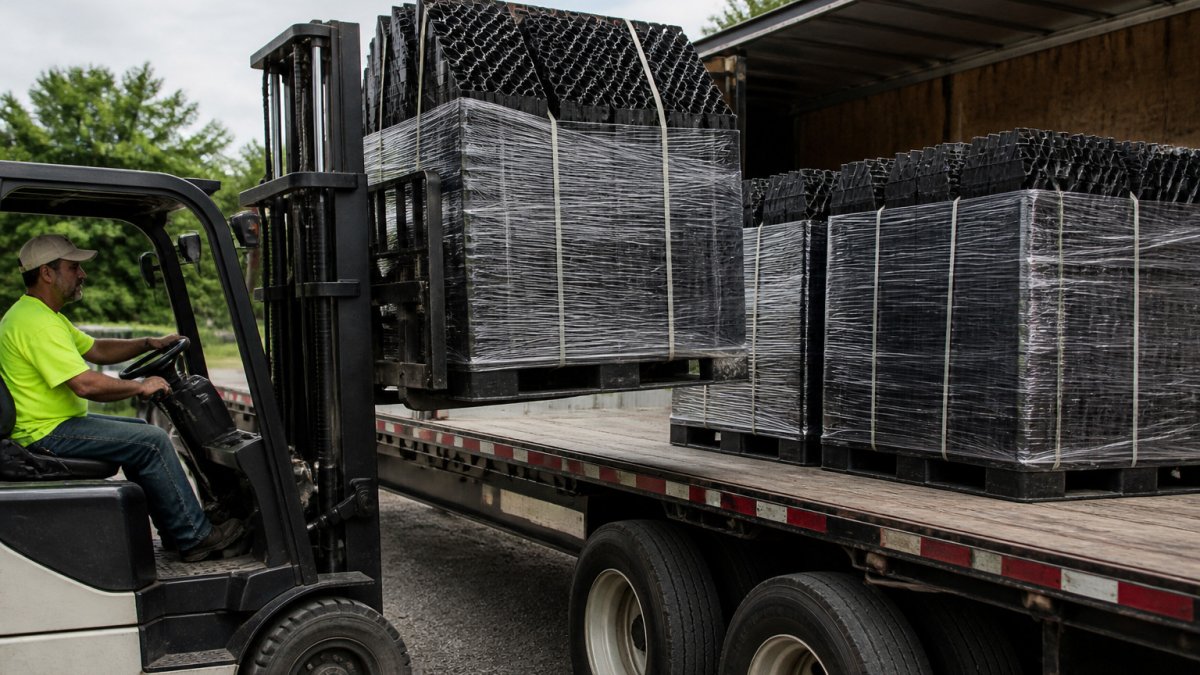
AirDrain panels are designed to nest, which lets more product fit onto each pallet. See how AirDrain AirPave pallets are stacked and palletized. Higher pallet density means fewer pallets and fewer truck positions, and that drives freight cost down. Browse photos of AirDrain and AirPave shipments and installs.
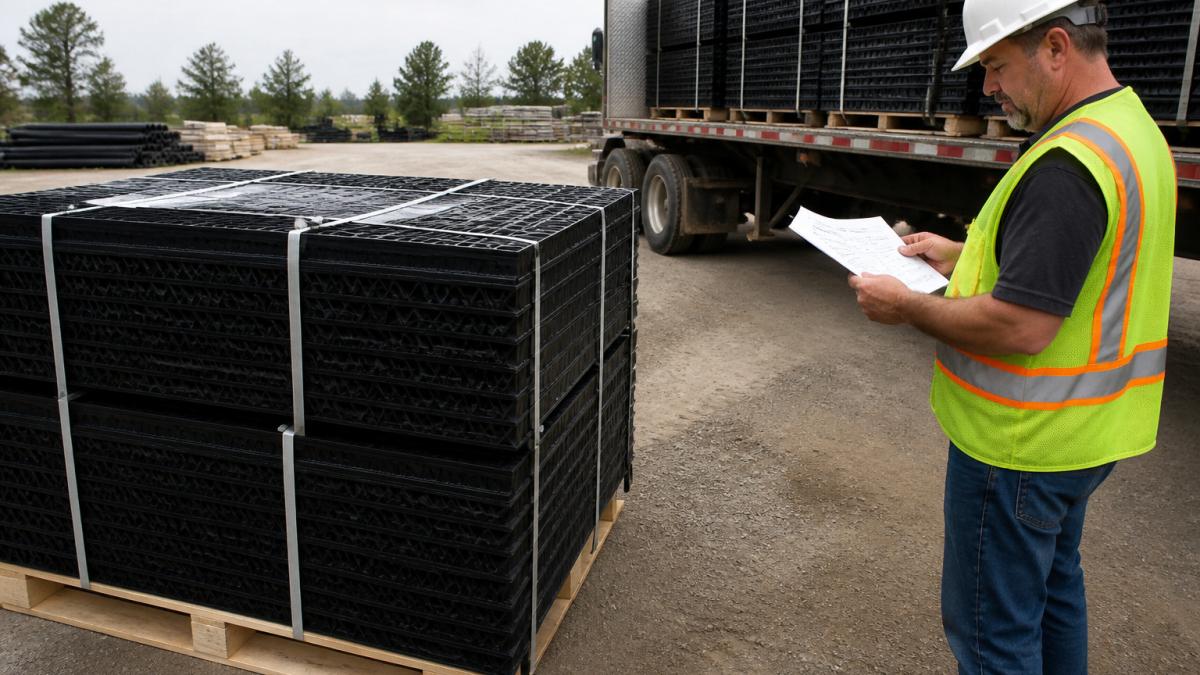
Some working numbers for planning:
- 114 parts per pallet
- 798 square feet per pallet
- About 395 pounds per pallet
Use these figures to estimate your pallet count. Divide your total square footage by 798 to get a rough pallet number, then confirm the final count with AirField Systems before ordering.
!A flatbed truck at a construction staging yard with stacked, nested geocell panels banded on wooden pallets, a site supervisor checking a delivery manifest
Advanced Drainage Systems notes that lightweight design and longer pipe lengths improve shipping efficiency and reduce transportation and installation costs (Advanced Drainage Systems, Streets and Highways). Optimizing inventory density through these logistical strategies serves as a foundational step toward cutting restocking costs across the entire supply chain.
Step 4: Plan Consolidated Deliveries and Jobsite Access
Consolidation means grouping orders and delivery dates so each truck carries more product. It also means confirming that the jobsite can receive the load when it arrives.
Consolidation tips:
- Combine phases of a project into one order where schedules allow
- Confirm delivery windows with the crew and general contractor
- Check whether the site needs a lift gate, liftgate-equipped truck or inside delivery
Jobsite access problems can add fees, so confirm the site can accept a full-size truck before the delivery day.
ShipJunction recommends reducing package weight and dimensions, consolidating shipments and selecting the right transport mode to lower freight costs (ShipJunction, How to Lower Shipping Costs in 2026).
Requesting a Freight Quote for Your Next Drainage Project
Before you request a quote, have these details ready:
- Total square footage and system layout
- Estimated pallet count and dimensions
- Delivery address, date and site access notes
With those inputs, AirField Systems can give you a quote that reflects your actual load. Ask for a per-square-foot freight estimate so you can compare options cleanly. Visit the AirField Systems website or contact the team directly to request a freight quote for your project.
Frequently Asked Questions
How does product nesting affect shipping costs for drainage systems?
Nesting lets components stack inside one another, so more units fit on each pallet and in each truck. Higher pallet density means fewer pallets, fewer freight charges and less wasted trailer space. AirDrain, for example, ships 114 parts per pallet covering 798 square feet, weighing about 395 pounds per pallet. Compare those figures against your current product’s per-pallet count to estimate freight savings before ordering. Pricing depends on quantity, dates and delivery, so request a current quote from AirField Systems.
What is the most cost-effective way to ship heavy construction materials?
For heavy materials, the cheapest option usually depends on total weight, pallet count and distance. Less-than-truckload (LTL) freight works well for smaller orders that share space with other shipments. Full truckload (FTL) becomes more economical when your order fills a trailer, because you avoid paying for shared handling and multiple stops. Consolidating orders into fewer, fuller shipments and scheduling deliveries in advance also reduces per-unit freight costs.
How can pallet density impact freight expenses for drainage projects?
Freight carriers price shipments based on weight and the space they occupy. Dense, well-palletized loads use trailer space efficiently, which lowers the cost per unit delivered. Loose or poorly stacked product can trigger higher freight class or dimensional weight charges. Review your pallet configuration with your supplier and confirm the dimensions and weight of each pallet before booking freight.
How do I calculate the freight cost per square foot for drainage materials?
Start with the total freight charge for the shipment, then divide by the total square footage delivered. For example, if a shipment covering 798 square feet per pallet costs a given amount in freight, divide that amount by 798 to get the freight cost per square foot. Include accessorial charges such as liftgate, residential delivery or jobsite access fees, since these affect the final figure. Use the same calculation for alternative shipping options to compare them directly.
